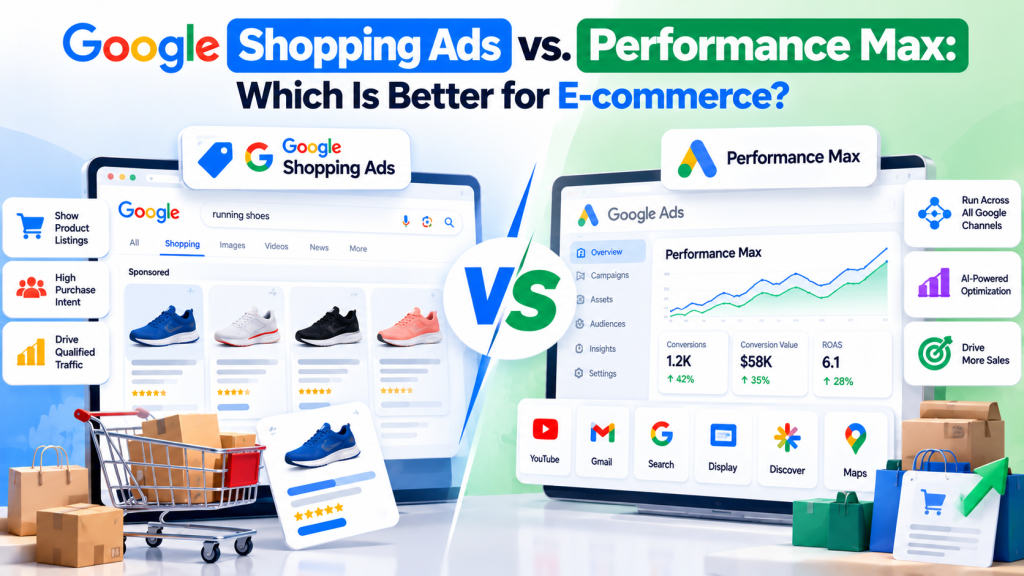
Running an e-commerce business and struggling to decide between Google Shopping Ads and Performance Max?
Both campaign types help online stores promote products and generate sales, but they work differently. Standard Shopping campaigns offer more direct control over product advertising, while Performance Max uses Google’s AI to reach customers across multiple advertising channels.
The real question is: Which campaign type generates better sales and return on ad spend (ROAS)?
The answer depends on your products, advertising budget, conversion data, and business goals.
Let’s compare Google Shopping Ads vs Performance Max to help you choose the right strategy for your online store.
What Are Google Shopping Ads?
Google Shopping Ads display products with images, prices, store names, and other relevant information.
These advertisements can appear in Google Search, the Shopping tab, Google Images, and eligible search partner placements.
Standard Shopping campaigns use product information from Google Merchant Center to determine relevant advertising opportunities.
They allow advertisers to manage product groups, bidding strategies, negative keywords, and campaign priorities.
Best suited for: E-commerce businesses that want more direct control over product-level advertising and search-driven sales.
What Is Performance Max?
Performance Max (PMax) is an AI-powered Google Ads campaign type designed to generate conversions or conversion value across multiple advertising channels.
It can promote e-commerce products through Google Search, Shopping, YouTube, Display, Gmail, Discover, and other eligible placements.
Performance Max uses automation for bidding, audience discovery, creative combinations, and ad delivery.
Best suited for: Online stores looking to expand customer reach and optimize sales across Google’s advertising inventory.
Google Shopping Ads vs Performance Max: Key Differences
| Feature | Standard Shopping | Performance Max |
|---|---|---|
| Advertising reach | Shopping-focused inventory | Multiple Google channels |
| Bidding | Manual CPC and automated options | Automated conversion-based bidding |
| Product feed | Merchant Center | Merchant Center |
| Creative assets | Primarily product feed | Product feed plus creative assets |
| Negative keywords | Supported | Supported with applicable controls |
| Campaign control | More granular | More automated |
| Best use case | Focused product advertising | Cross-channel sales growth |
Both campaign types can generate profitable sales when properly configured.
1. Which Campaign Offers Better Targeting Control?
Standard Shopping gives advertisers more direct control over product groups, bidding, and search-term exclusions.
For example, an online clothing store can organize products into separate groups for men’s shirts, women’s dresses, and accessories.
Performance Max relies more heavily on Google’s AI to identify relevant customer opportunities.
Advertisers can provide audience signals, search themes, product listing groups, and exclusions.
However, audience signals aren’t strict targeting limitations.
Verdict: Standard Shopping generally offers more direct control, while Performance Max emphasizes automated targeting and broader reach.
2. Which Campaign Is Better for Small Budgets?
Businesses with limited advertising budgets need to reduce wasted spending and prioritize profitable products.
Standard Shopping can be a useful starting point when advertisers want to focus primarily on Shopping inventory.
Performance Max can also work with smaller budgets, but results depend on conversion data, product demand, and campaign configuration.
There is no universal minimum budget that guarantees successful Performance Max results.
Verdict: Standard Shopping is worth considering for tightly controlled product advertising. Performance Max is worth testing when broader automated reach aligns with your goals.
3. Which Campaign Generates Better ROAS?
Return on Ad Spend measures attributed advertising revenue compared with advertising costs.
ROAS = Conversion Value ÷ Advertising Spend
For example, spending ₹10,000 and generating ₹40,000 in attributed sales gives a ROAS of 4.
Consider this hypothetical comparison:
| Metric | Shopping Ads | Performance Max |
|---|---|---|
| Spend | ₹20,000 | ₹20,000 |
| Purchases | 30 | 40 |
| Revenue | ₹75,000 | ₹90,000 |
| ROAS | 3.75 | 4.50 |
| Cost Per Purchase | ₹667 | ₹500 |
Performance Max performs better in this example, but actual results may differ.
A higher ROAS also doesn’t automatically mean higher profit. Product margins, shipping costs, returns, and discounts must be considered.
4. Which Is Better for New E-commerce Stores?
New stores often have limited purchase history and conversion data.
Standard Shopping may provide a more controlled way to begin product advertising and understand search demand.
Performance Max can also be launched without extensive historical data, but accurate purchase tracking and high-quality product information remain essential.
Before choosing either campaign, ensure your Merchant Center account is properly configured and products are approved.
5. Which Campaign Offers Better Reporting?
Standard Shopping provides useful reporting for products, search terms, and advertising performance.
Performance Max offers campaign insights, search-term reporting, asset performance information, and channel-level performance reporting.
However, its automated cross-channel optimization means advertisers should evaluate overall campaign results rather than relying only on individual channel metrics.
Both campaign types require regular performance monitoring.
6. Product Feed Optimization Matters for Both
Regardless of campaign type, a well-optimized Google Merchant Center feed is essential.
Focus on:
- Accurate product titles and descriptions
- High-quality product images
- Correct pricing and availability
- Relevant product categories
- Complete product identifiers
- Updated shipping and return information
Product feed quality affects how effectively Google understands and promotes your inventory.
7. Can You Run Shopping Ads and Performance Max Together?
Yes. Google allows Standard Shopping and Performance Max campaigns to advertise overlapping products.
When campaigns have overlapping targeting settings, Ad Rank determines which eligible campaign serves.
However, running both campaign types simultaneously doesn’t guarantee additional sales.
For a reliable comparison, Google provides a Performance Max versus Standard Shopping experiment option.
This allows advertisers to evaluate campaign performance through a controlled test instead of making assumptions based on overlapping campaigns.
Which Campaign Should Your Business Choose?
| Business Situation | Recommended Starting Point |
|---|---|
| Limited budget with strict product focus | Consider Standard Shopping |
| Need direct bid and product-group control | Standard Shopping |
| Want broader cross-channel reach | Performance Max |
| Have strong purchase tracking and creative assets | Test Performance Max |
| Want to compare both approaches | Run a controlled experiment |
These are practical starting points, not guaranteed performance outcomes.
Professional Google Ads services can help e-commerce businesses evaluate campaign structure, product feed quality, conversion tracking, and profitability.
Conclusion
Google Shopping Ads and Performance Max both offer valuable opportunities for e-commerce businesses.
Standard Shopping provides greater control over product advertising, while Performance Max uses automation to reach customers across multiple Google channels.
Instead of assuming one campaign type is always superior, evaluate your business requirements and compare results using reliable conversion data.
The best Google Ads strategy for e-commerce isn’t the campaign generating the most clicks or even the highest ROAS. It’s the one consistently delivering profitable sales and sustainable business growth.