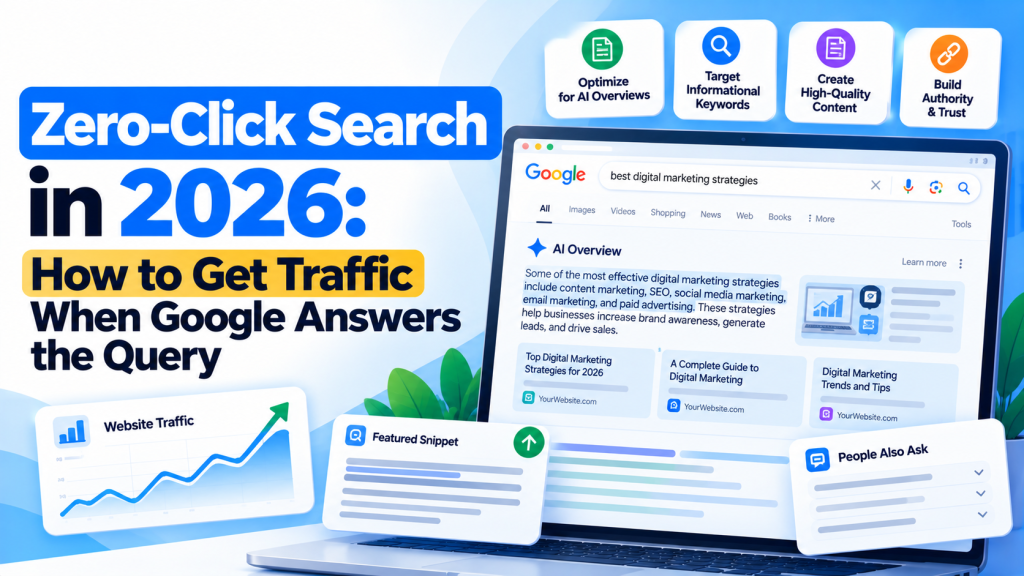
Imagine someone searching Google for “What is the best time to post on Instagram?” and getting the answer without visiting any website.
This is called a zero-click search, and it’s changing how businesses approach search engine optimization (SEO).
With Google AI Overviews, featured snippets, knowledge panels, and other search features providing direct answers, users don’t always need to click on traditional search results.
For businesses relying on organic traffic, this creates a challenge: How do you attract visitors when Google already answers their questions?
As we approach 2027, SEO strategies need to focus on more than keyword rankings. Businesses must prioritize search visibility, valuable content, and conversions.
Let’s explore how to adapt.
What Is Zero-Click Search?
A zero-click search occurs when someone finds the information they need directly on a search results page without visiting another website.
For example, searching “What is the capital of France?” typically provides an immediate answer.
Zero-click experiences can appear through:
- Google AI Overviews
- Featured snippets
- Knowledge panels
- Local business listings
- Calculators and other search features
These features help users find information quickly, but they can reduce the need to visit websites for simple answers.
However, zero-click searches don’t mean traditional SEO is becoming irrelevant.
Why Zero-Click Search Matters in 2027
Search behaviour is evolving as AI-powered features become more integrated into Google.
Users can now receive summarized information, compare options, and explore topics without immediately clicking through to websites.
This means businesses may receive search visibility without a corresponding increase in website visits.
For example, a digital marketing agency might appear in search results for “What is PPC advertising?” but receive limited traffic because users find a sufficient explanation directly on Google.
The challenge is to create content that offers more value than a short search result can provide.
1. Target Keywords That Encourage Website Visits
Not every search query has the same potential to generate clicks.
Simple informational searches can often be answered directly.
However, users researching services, comparing products, or making purchasing decisions may need additional information.
Focus on keywords such as:
- Best digital marketing agency for small businesses
- Google Ads management services
- SEO audit services for business websites
- Google Ads vs Meta Ads for lead generation
- How much do professional SEO services cost?
These searches may create opportunities for users to explore detailed service pages or comparisons.
Prioritize relevant commercial intent without abandoning helpful informational content.
2. Create Content That Goes Beyond Basic Answers
If your article only provides information Google can summarize in a few sentences, users may have little reason to visit your website.
Offer additional value through:
- Original case studies
- Detailed tutorials
- Expert insights
- Downloadable resources
- Practical comparisons
- Real-world examples
For example, instead of only explaining “What is Google Ads?”, create a guide showing how businesses can identify wasted advertising spend and improve lead quality.
Google recommends publishing unique, helpful content rather than information that merely repeats existing answers.
3. Optimize Content for Google AI Overviews
Google AI Overviews can summarize information and provide links to relevant websites.
To improve your content’s eligibility for discovery:
- Use clear, descriptive headings.
- Answer important questions directly.
- Publish accurate and original information.
- Maintain strong internal linking.
- Ensure important pages are crawlable and indexable.
- Keep content updated when information changes.
Google confirms that established SEO best practices remain relevant for AI search features. There is no special schema or guaranteed optimization method required for AI Overviews.
4. Focus on Long-Tail and Problem-Solving Keywords
Long-tail keywords often represent more specific customer needs.
For example:
Broad keyword: SEO services
Long-tail keyword: SEO services for small e-commerce businesses
Specific search queries can help businesses attract visitors looking for relevant solutions.
Create content addressing practical customer problems and clearly explain how your services solve them.
However, long-tail keywords aren’t automatically immune to zero-click results. Evaluate actual search intent before targeting them.
5. Strengthen Brand Visibility and Trust
Even when users don’t click immediately, seeing a business in relevant search experiences may introduce them to the brand.
Build a credible online presence through:
- Genuine customer reviews
- Accurate business information
- Helpful educational content
- Relevant industry mentions
- Original case studies
- Clear service descriptions
A trustworthy digital marketing agency should demonstrate its experience through practical examples rather than relying only on promotional claims.
Consistent branding can support recognition when potential customers encounter your business across different platforms.
6. Improve Local SEO and Google Business Profile
Local businesses can benefit from Google Search and Maps even when users don’t visit their websites.
For example, someone searching “digital marketing agency near me” may contact a business directly through its Google Business Profile.
Optimize your profile with accurate contact details, relevant categories, operating hours, and genuine customer reviews.
Monitor phone calls, website clicks, and other available business profile interactions.
For local service businesses, these actions can represent valuable results even without traditional website sessions.
7. Improve Landing Pages for Conversions
When organic visitors reach your website, make it easy for them to take the next step.
Your landing pages should provide:
- Clear service information
- Relevant customer benefits
- Visible contact buttons
- Simple enquiry forms
- Genuine testimonials
- Mobile-friendly navigation
For example, someone visiting a Google Ads services page should immediately understand what the business offers and how to request a consultation.
Improving conversion rates can help businesses generate more enquiries from existing traffic.
8. Track Search Visibility Beyond Organic Clicks
Traditional SEO reports often focus on keyword rankings and organic traffic.
Zero-click search requires broader measurement.
Monitor the following metrics:
| Metric | Why It Matters |
|---|---|
| Search Impressions | Measures visibility in Google results |
| Organic Clicks | Tracks website visits from Search |
| Click-Through Rate | Shows how often impressions generate clicks |
| AI Search Impressions | Measures exposure in Google’s supported generative AI features |
| Brand Search Trends | Helps monitor branded search demand |
| Organic Conversions | Measures enquiries and sales from organic traffic |
Google Search Console introduced dedicated Generative AI performance reporting in 2026, providing visibility insights for AI Overviews and AI Mode.
Use Google Analytics 4 to measure website engagement and conversions alongside search performance.
Common Zero-Click SEO Mistakes
Businesses should avoid several common mistakes when adapting their SEO strategies.
These include:
- Targeting only simple informational keywords
- Publishing generic content without original value
- Ignoring commercial search intent
- Measuring success only through website traffic
- Neglecting Google Business Profile optimization
- Publishing duplicate or repetitive AI-generated articles
- Ignoring website conversion performance
A balanced SEO strategy should support both search visibility and measurable customer acquisition.
Conclusion
Zero-click search is changing how businesses attract customers through Google.
As AI Overviews and other search features provide more direct answers, relying only on traditional keyword rankings and traffic volume may become less effective.
Businesses should focus on creating original content, targeting meaningful search intent, strengthening brand credibility, and improving website conversion rates.
The future of SEO in 2027 isn’t simply about generating more clicks. It’s about building search visibility that leads to qualified traffic, customer enquiries, and measurable business growth.