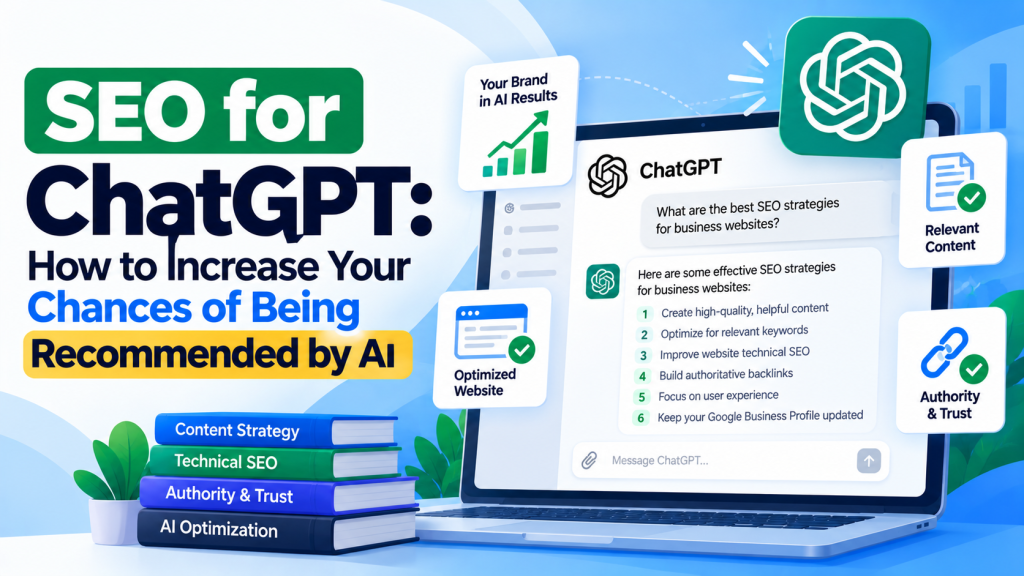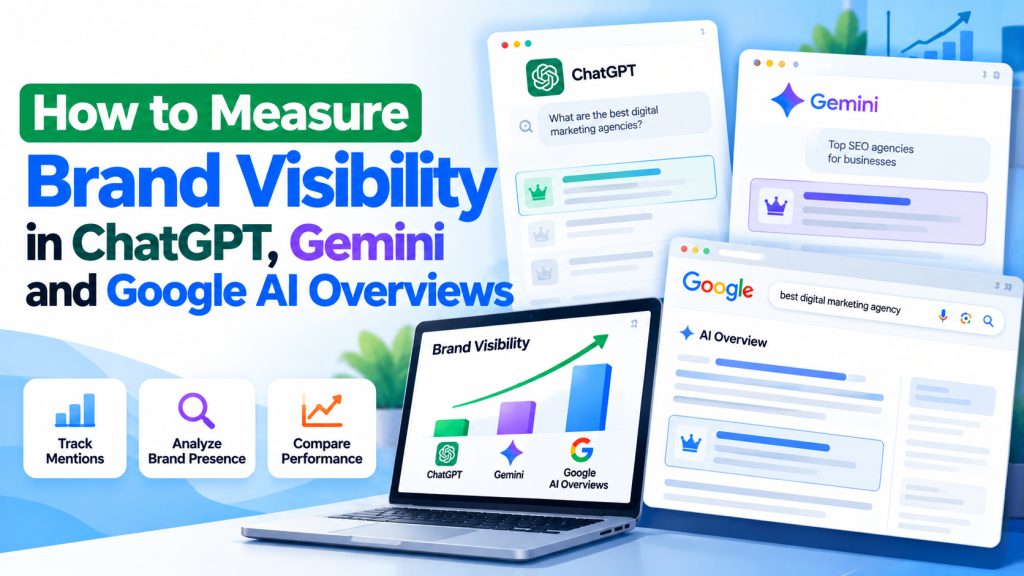
Are people discovering your business through ChatGPT, Google Gemini, or AI Overviews? More importantly, do you know whether these platforms are mentioning your brand or recommending your services?
AI-powered search is changing how customers research products, compare businesses, and make purchasing decisions.
Instead of browsing multiple websites, users can ask AI assistants for direct recommendations. This creates new opportunities for businesses, but traditional SEO metrics don’t tell the complete story.
Measuring brand visibility in AI search requires tracking brand mentions, website citations, referral traffic, and conversions.
In this guide, you’ll learn practical ways to monitor your brand’s presence across AI search platforms.
What Is Brand Visibility in AI Search?
AI brand visibility refers to how frequently and prominently a business appears in AI-generated answers, recommendations, and supporting sources.
For example, someone might ask ChatGPT:
“Which companies provide reliable digital marketing services for small businesses?”
If an AI assistant mentions your business or links to your website, that represents an opportunity for brand exposure.
AI visibility can include:
- Brand mentions in AI-generated answers
- Website links and citations
- Product or service recommendations
- Visibility in Google AI Overviews
- Referral traffic from AI assistants
However, AI responses can vary depending on the question, user context, and available information.
1. Monitor Brand Mentions in ChatGPT
One practical way to evaluate ChatGPT visibility is to test relevant customer questions.
For example:
- Which companies offer digital marketing services?
- What are the best Google Ads agencies for small businesses?
- Which agencies specialize in lead generation?
- Who provides SEO services for local businesses?
Review whether your brand appears in the responses.
Record the questions, dates, brand mentions, and website citations.
Repeat the process periodically using consistent prompts and settings.
Important: Manual prompt testing provides a sample of AI visibility, not a complete measurement of every ChatGPT recommendation.
2. Check Brand Visibility in Google Gemini
Gemini can help users research companies, compare services, and discover information.
To monitor your visibility, test questions relevant to your business and industry.
For example:
“Which digital marketing services are suitable for an e-commerce business?”
Check whether Gemini mentions your business, references your website, or includes competitors.
Keep a record of your results to identify changes over time.
Avoid assuming that one response represents your overall visibility, because AI-generated answers can change.
3. Track Google AI Overviews Using Search Console
Google Search Console provides a dedicated Generative AI performance report for measuring website visibility in Google’s AI-powered search features.
The report includes impressions from Google AI Overviews and AI Mode.
You can use it to understand:
- How frequently your website appears in supported AI search features
- Which pages receive AI impressions
- Visibility trends over time
- Performance by country and device
An impression indicates that a link to your website appeared in a supported generative AI search experience.
The report measures website visibility rather than every text-only brand mention.
4. Track AI Referral Traffic in Google Analytics 4
Google Analytics 4 helps businesses measure visitors arriving from supported AI assistants.
To check your AI referral traffic:
- Open Google Analytics 4.
- Navigate to Reports → Acquisition → Traffic acquisition.
- Look for the AI Assistant channel.
- Select Session source / medium to examine individual sources.
- Review sessions, engagement, and key events.
GA4’s AI Assistant channel includes qualifying traffic from platforms such as ChatGPT, Gemini, and Copilot.
Google AI Overviews and AI Mode are excluded from this channel because they are part of Google Search.
5. Measure Brand Mentions and AI Citations
Brand mentions and website citations are different indicators.
A brand mention occurs when an AI assistant names your company.
A website citation occurs when the response provides a source link referencing your content.
For example, ChatGPT might mention a marketing agency without linking to its website. Alternatively, it might cite an agency’s educational article without recommending its services.
Both situations are useful to track separately.
You can measure sampled brand mention rate using:
Brand Mention Rate = (Responses Mentioning Your Brand ÷ Total Tested Responses) × 100
For example, if your brand appears in 15 out of 50 consistently tested responses, your sampled mention rate is 30%.
This is a monitoring metric, not an official ranking score provided by AI platforms.
6. Compare Your Visibility With Competitors
Competitor analysis helps identify which businesses appear for relevant customer questions.
Select a consistent list of prompts and record:
- Your brand mentions
- Competitor mentions
- Website citations
- Type of recommendations
- Changes between reporting periods
For example, if competitors frequently appear for questions about Google Ads management but your company doesn’t, review whether your website adequately explains that service.
Use findings to identify content gaps rather than trying to manipulate AI-generated answers.
7. Track Conversions From AI Search
Brand exposure is valuable, but businesses also need to measure enquiries and sales.
Configure relevant GA4 key events such as:
- Contact form submissions
- Appointment bookings
- Qualified enquiries
- Purchases
Then review conversions from identifiable AI Assistant traffic.
This helps determine whether visitors from ChatGPT, Gemini, and other platforms contribute to business results.
Remember that some users may discover your brand through AI and later return through Google Search or directly. These indirect interactions aren’t always attributable to AI.
AI Brand Visibility Metrics to Monitor
| Metric | What It Measures |
|---|---|
| Brand Mention Rate | Percentage of tested responses mentioning your brand |
| Citation Rate | Percentage of responses linking to your website |
| AI Search Impressions | Website exposure in Google’s AI features |
| AI Referral Sessions | Visits attributed to AI assistants |
| AI-Attributed Leads | Recorded enquiries from AI-referred traffic |
| Competitor Mentions | Competitor visibility across tested prompts |
Track these metrics monthly using consistent methods to identify meaningful trends.
How to Improve Brand Visibility in AI Search
Once you’ve established baseline measurements, focus on improving your website’s content and credibility.
Effective practices include:
Create helpful content: Publish detailed answers to common customer questions.
Demonstrate expertise: Add genuine case studies, useful examples, and clear service information.
Strengthen technical SEO: Ensure important pages are accessible to relevant search crawlers.
Maintain consistent business details: Keep your website and relevant business profiles accurate.
Improve internal linking: Connect related educational articles with appropriate service pages.
Build topical relevance: Cover topics closely connected to your expertise, including SEO, paid advertising, analytics, and digital marketing services.
These activities can support discoverability, but no optimization technique guarantees an AI recommendation.
Conclusion
Measuring brand visibility in ChatGPT, Gemini, and Google AI Overviews is becoming an important part of digital marketing performance analysis.
Businesses should look beyond traditional keyword rankings and monitor AI-generated brand mentions, website citations, referral traffic, and conversions.
By combining Google Search Console, Google Analytics 4, and consistent AI visibility testing, businesses can better understand how customers discover their brands through AI-powered search.
The goal isn’t simply to appear in AI answers. It’s to turn AI-driven brand visibility into relevant website traffic, qualified leads, and measurable business growth.