Are potential customers searching for your services on Google but finding your competitors instead?
For service-based businesses, appearing in local search results can make a significant difference in generating enquiries, phone calls, and bookings.
Whether you run a plumbing company, dental clinic, cleaning service, or home renovation business, customers often search for services available in their nearby areas.
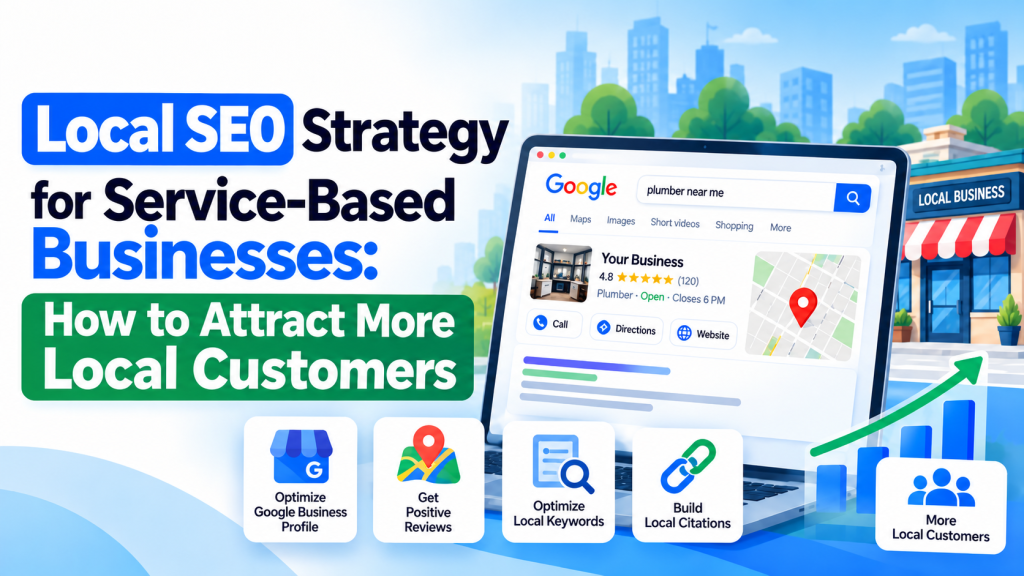
A strong local SEO strategy for service-based businesses helps improve visibility on Google Search and Google Maps, connecting your business with people actively looking for your services.
In this guide, we’ll explore practical local SEO strategies to help attract more relevant customers.
What Is Local SEO for Service-Based Businesses?
Local SEO is the process of optimizing your website and online business presence to improve visibility in location-based search results.
For example, someone searching for “AC repair near me” or “best dentist in Delhi” may see relevant businesses in Google Maps and organic search results.
Google primarily evaluates local search results using three factors:
- Relevance: How closely your business matches the search query.
- Distance: How close your business is to the searcher’s location.
- Prominence: How well-known and established your business appears.
Improving your online presence can strengthen your local search performance, although rankings also depend on competition and proximity.
1. Optimize Your Google Business Profile
Your Google Business Profile (GBP) is one of the most important elements of local SEO.
An accurate, well-maintained profile helps customers discover your services through Google Search and Maps.
Focus on:
- Selecting the most relevant primary business category
- Adding accurate contact information
- Listing your services and operating hours
- Uploading genuine business photos
- Keeping your business description informative
- Maintaining accurate service areas
If you visit customers at their locations and don’t serve them at your business address, configure your profile as a service-area business and hide the address where required.
Avoid adding keywords unnaturally to your business name.
2. Target Location-Based Keywords
Local keyword research helps identify what nearby customers search for.
For example, a cleaning company might target:
- House cleaning services in Delhi
- Deep cleaning company near me
- Office cleaning services in Noida
- Professional sofa cleaning in Gurgaon
Use relevant keywords naturally in page titles, headings, service descriptions, and website content.
Avoid repeating location names excessively or targeting cities your business doesn’t actually serve.
3. Create Dedicated Service Pages
Each important service should have a clear, informative page on your website.
For example, a home maintenance business might create separate pages for AC repair, plumbing, and electrical services.
Include service details, customer benefits, service availability, trust signals, and clear calls to action.
A well-structured service page helps customers understand what you offer and how to contact you.
4. Build Relevant Location Pages
Businesses serving multiple cities can create dedicated location pages when each page provides useful, location-specific information.
For example:
example.com/ac-repair-delhi/
example.com/ac-repair-noida/
Each page should explain the services available in that area and include genuinely relevant details.
Avoid publishing dozens of nearly identical pages that only change the city name. Such pages may provide little value and create doorway-page concerns.
5. Encourage Genuine Customer Reviews
Customer reviews influence trust and can support local search visibility.
Encourage satisfied customers to leave honest feedback on your Google Business Profile.
Respond professionally to both positive and negative reviews.
Never purchase reviews, offer prohibited incentives, or publish fabricated testimonials.
Authentic reviews help potential customers make informed decisions.
6. Maintain Consistent Business Information
Your business name, address where publicly applicable, and phone number should remain accurate across important online platforms.
Check your website, Google Business Profile, and relevant business directories.
For service-area businesses that hide their address, don’t publish a private address simply to maintain directory consistency.
Focus on accurate information rather than creating large numbers of low-quality directory listings.
7. Improve Mobile Experience and Website Speed
Many local searches happen on smartphones, especially when people need immediate services.
Your website should load efficiently and make it easy to contact your business.
Important elements include:
- Click-to-call buttons
- Mobile-friendly enquiry forms
- Clear service descriptions
- Visible contact information
- Simple website navigation
Use Google PageSpeed Insights to identify technical issues affecting website performance.
8. Add Local Business Schema Markup
LocalBusiness structured data helps search engines understand important details about eligible businesses.
Depending on your business type, it may describe information such as operating hours, contact details, and physical location.
Use accurate structured data that reflects your actual business information.
Test your implementation using Google’s Rich Results Test.
Structured data helps search engines interpret content but doesn’t guarantee improved rankings.
9. Build Relevant Local Backlinks
Links from credible local websites can support your business’s online prominence.
Potential sources include local business associations, industry organizations, community partnerships, and relevant publications.
For example, a home renovation company might earn a link from a local industry directory or a publication featuring completed projects.
Avoid purchasing spammy backlinks or participating in link schemes.
Focus on genuine business relationships and relevant mentions.
10. Track Local SEO Leads and Performance
Local SEO success shouldn’t be measured only by keyword rankings.
Businesses should monitor actual enquiries and customer acquisition.
Use Google Search Console, Google Analytics 4, and Google Business Profile performance data.
Track:
| Metric | Why It Matters |
|---|---|
| Local Organic Clicks | Measures search traffic to your website |
| Google Business Profile Interactions | Shows calls, clicks, and other profile actions |
| Phone Enquiries | Measures customer interest |
| Form Submissions | Tracks website enquiries |
| Qualified Leads | Identifies relevant potential customers |
| Customer Acquisition | Connects SEO with business results |
Use UTM parameters on your Business Profile website link where appropriate to improve traffic attribution in analytics.
Common Local SEO Mistakes to Avoid
Even businesses investing in SEO can make mistakes that limit their local visibility.
Common problems include:
- Incomplete Google Business Profiles
- Incorrect business categories
- Inconsistent contact details
- Duplicate or low-value location pages
- Missing local search keywords
- Poor mobile user experience
- Ignoring customer reviews
- Focusing only on rankings instead of leads
A regular local SEO audit can help identify these issues and prioritize improvements.
Conclusion
A successful local SEO strategy for service-based businesses focuses on reaching nearby customers who genuinely need your services.
Optimizing your Google Business Profile, targeting relevant local keywords, creating useful service pages, collecting genuine reviews, and improving website usability can strengthen your local search presence.
However, visibility alone isn’t the final goal.
The real success of local SEO is measured by qualified enquiries, booked appointments, and customers generated through local search.
With consistent optimization and accurate performance tracking, service-based businesses can build stronger local visibility and create sustainable opportunities for growth.