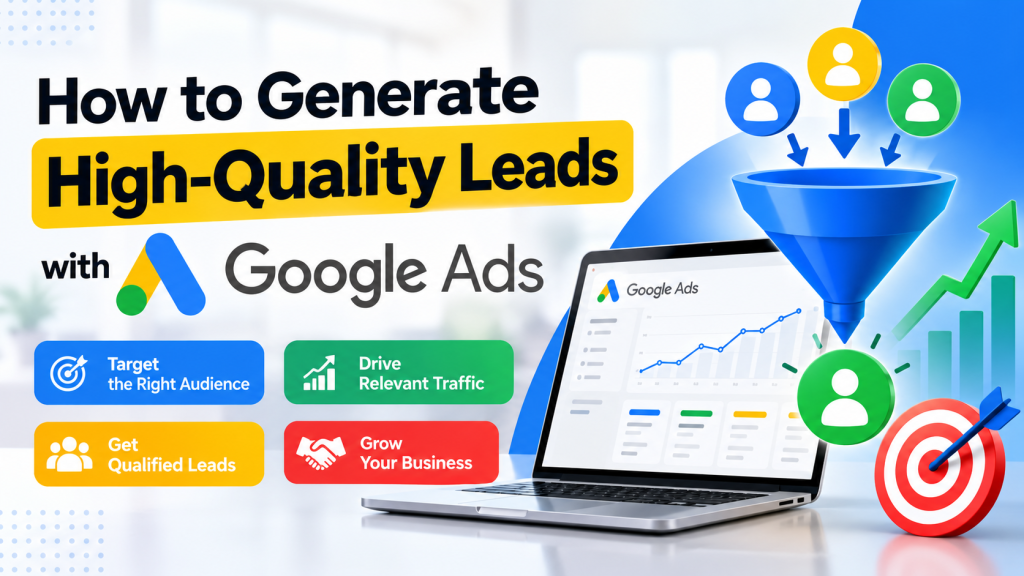
Getting leads is easy. Getting high-quality leads that can actually turn into paying customers is the real challenge.
Many businesses invest money in Google Ads but still struggle with irrelevant calls, low-quality form submissions, expensive leads, or people who are simply not ready to buy.
The problem is often not Google Ads itself. It is how the campaigns are planned, targeted, tracked, and optimized.
With the right Google Ads services and lead generation strategy, businesses can reach people who are actively searching for their products or services and turn those searches into genuine business opportunities.
In this guide, we’ll explain how to generate high-quality leads with Google Ads and how professional Google Ads management services can help you get better results from your advertising budget.
Why Use Google Ads for Lead Generation?
Google Ads is powerful for lead generation because it allows you to reach potential customers when they are actively searching for a solution.
For example, someone searching:
- “commercial cleaning company near me”
- “best immigration consultant in Delhi”
- “emergency AC repair”
- “Google Ads agency for ecommerce”
- “business setup consultant Dubai”
is showing much stronger intent than someone who simply sees an advertisement while browsing social media.
This is why Google Search Ads can work particularly well for service-based businesses.
However, simply running ads is not enough.
Your keywords, campaign structure, ad copy, landing page, conversion tracking, bidding strategy, and ongoing optimization all need to work together.
A professional Google Ads agency focuses on the complete customer journey rather than just increasing clicks.
1. Target High-Intent Keywords
Keyword selection is one of the most important parts of Google Ads lead generation.
Not every keyword has the same commercial value.
For example, consider these searches:
“What is digital marketing?”
and
“Google Ads management agency near me”
The first person is probably looking for information.
The second person may be actively searching for a company to manage their Google Ads campaigns.
That difference is called search intent.
If your goal is lead generation, focus more heavily on keywords that indicate the user is looking for a service, company, quote, consultation, provider, or solution.
High-intent keywords can include phrases such as:
Service-based keywords
- Google Ads services
- PPC management services
- Google PPC services
- Google Ads management services
Provider-based keywords
- Google Ads agency
- PPC agency
- Google Ads company
- Google Ads expert
Action-based keywords
- Hire Google Ads expert
- Get PPC consultation
- Google Ads management company
- PPC services for small business
These searches are closer to a business decision than general informational searches.
The goal shouldn’t simply be to find keywords with high search volume. You need to identify keywords that have a realistic chance of generating customers.
2. Understand What Your Customer Actually Wants
Before creating a campaign, understand why someone would search for your service.
Ask yourself:
What problem does the customer have?
What solution are they searching for?
How urgently do they need it?
What would make them contact one company instead of another?
Suppose you offer property damage claim assistance.
A person searching “what is a public adjuster?” may still be researching.
Someone searching “public adjuster for water damage near me” has a much clearer requirement.
Your Google Ads lead generation strategy should prioritize searches that indicate stronger buying intent.
Understanding this intent helps you improve your keywords, advertisements, landing pages, and offers.
3. Create Separate Ad Groups for Different Services
One common Google Ads mistake is putting many unrelated keywords into the same ad group.
Imagine a company provides:
- SEO services
- Google Ads management
- Meta Ads management
- Website development
Putting all these services into one ad group can make the advertisements less relevant.
Instead, campaigns should be organized around specific services or themes.
For example:
Ad Group 1 – Google Ads Services
Keywords could include Google Ads services, Google Ads management services, Google PPC services, and Google Ads company.
Ad Group 2 – PPC Agency
Keywords could include PPC agency, PPC management company, PPC advertising agency, and PPC management services.
Ad Group 3 – Google Ads Expert
Keywords could include Google Ads expert, hire Google Ads expert, Google PPC expert, and Google Ads consultant.
This makes it easier to create advertisements that closely match what the person searched for.
Better relevance can improve both user experience and campaign performance.
4. Write Ads That Match Search Intent
Your advertisement should immediately answer the question:
“Why should I click this ad?”
Avoid writing generic advertisements that could belong to almost any company.
Instead of:
We Provide Excellent Digital Marketing Services. Contact Us Today.
Use messaging that directly addresses what the customer wants.
For example:
Looking for Better Leads from Google Ads?
Get Professionally Managed PPC Campaigns Focused on Leads, Sales & ROI.
Your advertisements can highlight relevant benefits such as:
- Experienced Google Ads management
- Lead-focused campaign strategy
- Conversion tracking setup
- Keyword and search-term optimization
- Transparent reporting
- Landing page recommendations
- PPC campaign optimization
Your ad should make the next step clear.
Depending on the business, the CTA could be:
Get a Free Consultation
Request a Quote
Talk to a Google Ads Expert
Book Your Consultation
Call Now
Clear calls to action help attract users who are ready to take the next step.
5. Send Traffic to the Right Landing Page
Getting the click is only half the job.
The landing page needs to convert that visitor into a lead.
If someone searches for Google Ads management services, they should ideally land on a page specifically explaining your Google Ads management service.
Don’t send every visitor to a generic homepage.
A strong landing page should quickly explain:
What you offer
Make your service immediately clear.
Who the service is for
Help visitors understand whether your solution matches their needs.
What problem you solve
Focus on business outcomes rather than only technical features.
Why customers should trust you
Use relevant case studies, testimonials, experience, certifications, reviews, or measurable results where available.
What the visitor should do next
Use a visible CTA such as:
Request a Google Ads Consultation
Avoid making visitors search around the website to figure out how to contact you.
6. Use Negative Keywords to Reduce Wasted Spend
Negative keywords are extremely important for improving lead quality.
They prevent your advertisements from appearing for searches that aren’t relevant to your business.
For example, a company selling professional Google Ads management services may not want to pay for searches from people looking for:
- Google Ads jobs
- Google Ads salary
- free Google Ads course
- Google Ads certification questions
- Google Ads internship
- how to learn Google Ads
- Google Ads tutorial
These users may be interested in Google Ads, but they are not necessarily looking to hire an agency.
Adding irrelevant searches as negative keywords can reduce wasted clicks and help direct more budget toward commercially relevant traffic.
Negative keyword management should therefore be an ongoing part of professional PPC management services.
7. Track Real Conversions, Not Just Clicks
Clicks do not automatically mean business.
Imagine two campaigns.
Campaign A generates:
1,000 clicks and 20 leads
Campaign B generates:
500 clicks and 40 leads
Campaign B has fewer clicks but produces twice as many leads.
That is why businesses shouldn’t judge Google Ads performance based only on traffic.
Important lead generation metrics can include:
- Conversions
- Conversion rate
- Cost per lead (CPL)
- Qualified leads
- Cost per qualified lead
- Phone calls
- Form submissions
- Booked appointments
- Sales opportunities
- Revenue generated
Where possible, businesses should also track what happens after a lead enters the CRM.
This helps distinguish between simply generating leads and generating qualified leads that contribute to revenue.
8. Improve Your Conversion Tracking
Google Ads optimization depends heavily on the conversion data you provide.
If conversion tracking is incomplete or incorrect, it becomes harder to understand which campaigns, keywords, ads, and landing pages are producing meaningful results.
Depending on the business, you may need to track:
- Contact form submissions
- Phone calls
- Appointment bookings
- Quote requests
- WhatsApp or other messaging actions
- Purchases
- Qualified leads
- Closed sales
For lead generation businesses, tracking every form submission as equally valuable can also create problems.
A spam submission and a qualified sales enquiry are not the same.
A more advanced Google Ads management strategy can connect advertising data with CRM or offline conversion data so optimization is based on deeper funnel outcomes where appropriate.
9. Regularly Review Search Terms
Search terms show what people actually typed before interacting with your advertisements.
This report can reveal valuable information.
You may discover:
High-quality searches
These can potentially become new keywords or inspire new ad groups.
Irrelevant searches
These may need to be added as negative keywords.
New customer needs
Search behavior can reveal problems or services that customers care about.
Different levels of intent
Some searches may generate lots of traffic but very few qualified enquiries.
A good Google Ads expert doesn’t simply launch a campaign and leave it running.
Search behavior should be reviewed regularly so the campaign becomes more focused over time.
10. Don’t Optimize Only for Cheap Leads
A lower CPL is not always better.
Consider this example.
Campaign A
Cost per lead: ₹500
Leads: 100
Qualified leads: 10
Campaign B
Cost per lead: ₹800
Leads: 70
Qualified leads: 30
Campaign A appears cheaper when you look only at CPL.
But Campaign B generates significantly more qualified leads.
This is why businesses should look beyond the initial cost per conversion.
The real question is:
How much are you paying for a lead that has a genuine chance of becoming a customer?
Professional Google Ads lead generation services should focus on business quality, not simply producing the cheapest possible form submissions.
11. Optimize Campaigns Continuously
Google Ads is not a “set it and forget it” platform.
Campaign performance can change because of competition, customer demand, keyword behavior, landing pages, bidding, seasonality, budgets, and many other factors.
Regular optimization may include:
- Reviewing search terms
- Adding negative keywords
- Testing new ad copy
- Adjusting keyword targeting
- Monitoring conversion rates
- Reviewing bidding strategies
- Analyzing location performance
- Checking device performance
- Improving landing pages
- Reviewing conversion tracking
- Monitoring lead quality
- Adjusting budget allocation
This ongoing process is one of the main reasons businesses use professional Google Ads management services rather than simply launching campaigns and leaving them untouched.
Why Businesses Choose Professional Google Ads Services
Managing Google Ads effectively requires more than knowing how to create a campaign.
You need to understand customer search behavior, keyword intent, bidding, conversion tracking, landing pages, campaign structure, lead quality, and data analysis.
Professional Google Ads services can help businesses create a more structured advertising system focused on measurable outcomes.
A Google Ads agency can typically help with:
- Google Ads account setup
- Keyword research
- Competitor research
- Search campaign management
- Performance Max campaign management
- PPC strategy
- Conversion tracking
- Remarketing
- Landing page recommendations
- Campaign optimization
- Lead quality analysis
- Performance reporting
The objective is not simply to spend your advertising budget.
The objective is to use that budget to reach people who are most likely to become customers.
How to Choose the Right Google Ads Agency
Before hiring a Google Ads agency, don’t judge the company only on promises of more traffic or cheaper clicks.
Ask questions such as:
How will you identify high-intent keywords?
How will you track conversions?
How do you reduce irrelevant leads?
How often do you review search terms?
How will you measure lead quality?
Will you provide transparent performance reports?
How do you connect campaign performance with actual business results?
A reliable PPC management company should be able to explain its strategy in language you understand.
You should know where your advertising budget is going and what results it is producing.
Final Thoughts
Google Ads can be an effective lead generation channel when campaigns are built around customer intent, accurate targeting, relevant advertisements, strong landing pages, proper conversion tracking, and continuous optimization.
The goal should not be to generate the maximum number of clicks.
It should be to attract the right people at the right moment and turn those searches into genuine business opportunities.
If your campaigns are generating traffic but not enough qualified enquiries, your targeting, keywords, conversion tracking, landing page, or optimization strategy may need improvement.
Professional Google Ads management services can help identify these gaps and build campaigns focused on qualified leads rather than vanity metrics.
Looking for Google Ads Management Services?
If you want to generate more qualified enquiries through Google Search, Shopping, Performance Max, or other PPC campaigns, working with an experienced Google Ads expert can help you build a more focused advertising strategy.
From keyword research and campaign setup to conversion tracking and ongoing optimization, the right Google Ads services should be focused on one thing:
Turning your advertising budget into measurable business opportunities.
Contact us today to discuss your Google Ads requirements and build a PPC strategy focused on qualified leads, better conversion rates, and sustainable business growth.