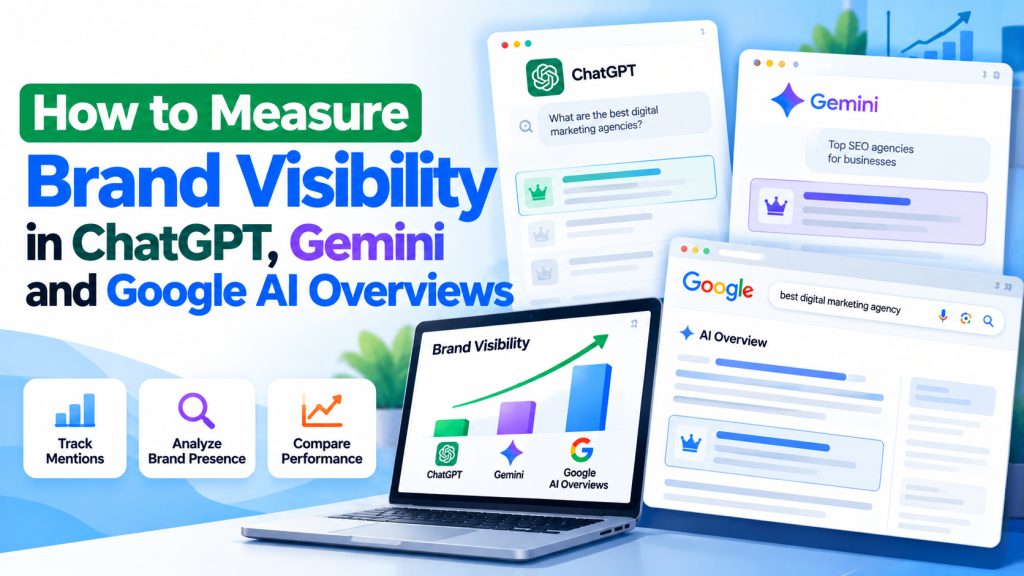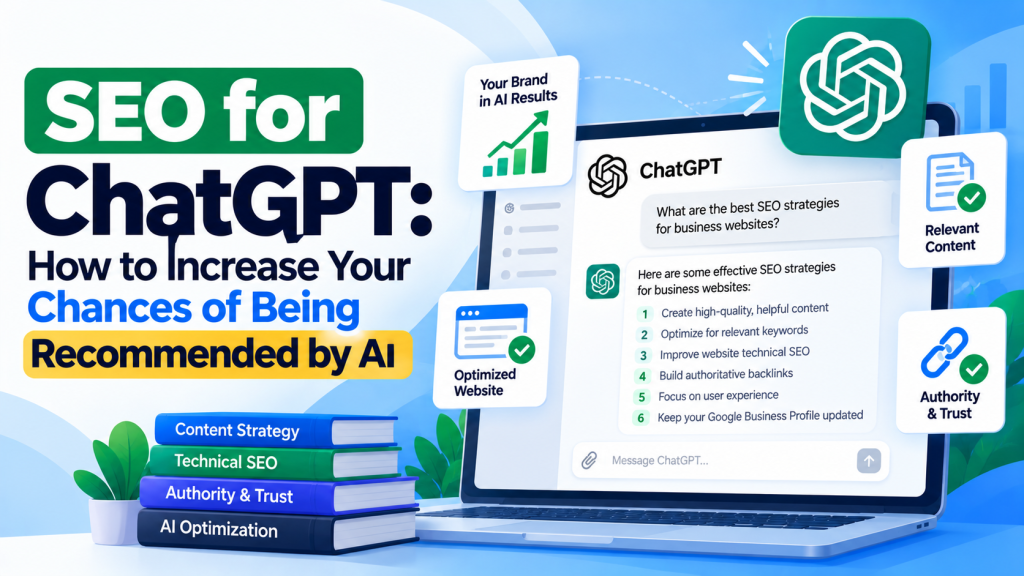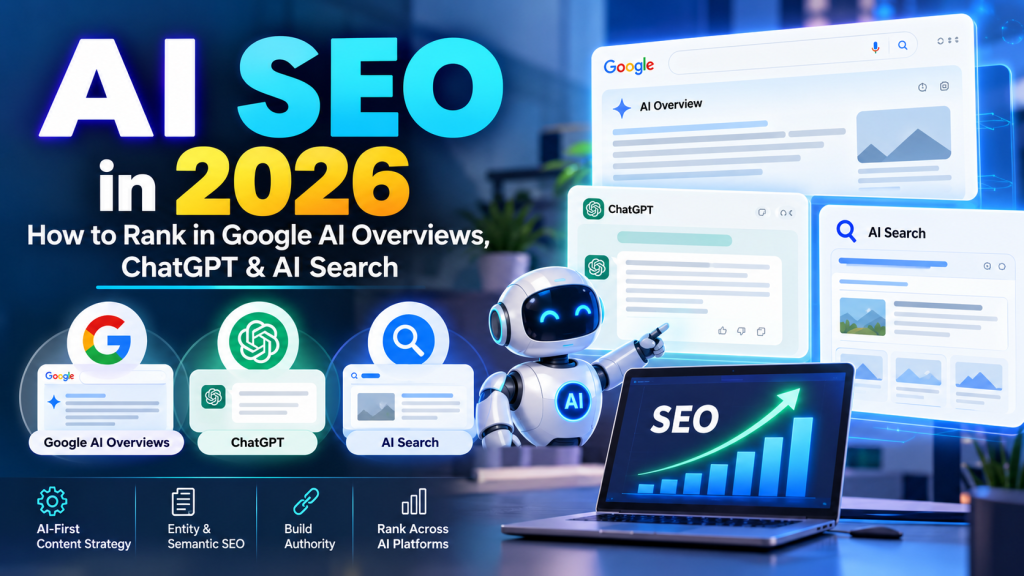
Today, your potential customers may search on Google and get their answer directly from an AI Overview. They may use ChatGPT to research a service, compare companies, shortlist products, or understand a problem before they ever visit a website.
This creates an important question for businesses and marketers:
How do you make your website and brand visible when AI generates the answer?
The answer is AI SEO.
AI SEO does not replace traditional Search Engine Optimization. Instead, it expands SEO to account for how information is discovered, retrieved, understood, cited, and recommended across AI-powered search experiences.
In 2026, businesses need to think beyond rankings and focus on retrieval, citations, entities, authority, information quality, brand visibility, and conversions.
What Is AI SEO?
AI SEO is the process of improving a website and brand’s visibility across traditional search engines and AI-powered discovery platforms such as Google AI Overviews, Google AI Mode, ChatGPT Search, Microsoft Copilot, and other generative search systems.
AI SEO combines established SEO principles with additional emphasis on:
- Crawlability and indexability
- Original and expert-led information
- Clear answers to real customer questions
- Strong entity and topical signals
- Accurate and verifiable information
- Content suitable for supporting AI-generated answers
- Brand authority across the web
- AI citations, mentions, referral traffic, and conversions
You may also encounter terms such as Generative Engine Optimization (GEO), Answer Engine Optimization (AEO), LLM SEO, and AI Search Optimization.
The terminology may differ, but the business objective is essentially the same:
Make your business a trustworthy, useful, and discoverable source wherever your audience searches.
Is Traditional SEO Dead in 2026?
No.
Traditional SEO remains the foundation of AI search visibility.
Technical SEO, quality content, internal linking, page experience, authority, and search intent are still important.
What has changed is the customer journey.
A traditional search journey may look like this:
Search Query → Google Results → Website → Decision
An AI-assisted search journey may look like:
Complex Question → AI Answer → Follow-Up Questions → Brand/Source Discovery → Website → Decision
This means businesses need content that supports customers throughout a much broader research and decision-making journey.
SEO vs AEO vs GEO: What’s the Difference?
Although these terms are often discussed separately, they overlap considerably.
| Approach | Primary Goal | Typical Visibility |
|---|---|---|
| SEO | Improve organic search visibility | Traditional Google and Bing results |
| AEO | Provide clear, direct answers | Featured answers, voice search and answer experiences |
| GEO | Improve visibility inside generative answers | AI-generated responses and citations |
| AI SEO | Combine traditional and AI search visibility | Google, AI Overviews, ChatGPT and other AI search environments |
For most businesses, building four separate strategies isn’t necessary.
A better approach is creating one comprehensive search strategy that makes your information useful to both people and search retrieval systems.
How AI Search Changes the Way Content Is Discovered
Traditional SEO has often been approached as:
One Keyword → One Page → One Ranking
AI-powered search creates a much broader information-retrieval process.
Imagine someone asks:
“What is the best digital marketing strategy for a small ecommerce business?”
Answering this properly could require information about:
- Ecommerce SEO
- Google Ads
- Social media advertising
- Email marketing
- Conversion optimization
- Marketing budget allocation
- Analytics and measurement
- Strategies for new vs. established ecommerce stores
The original query therefore represents an entire information need rather than one isolated keyword.
For SEO in 2026, businesses should increasingly think in terms of:
Topic → Customer Problems → Related Questions → Supporting Evidence → Entities → Complete Solution
Instead of repeating “ecommerce digital marketing” throughout an article, a strong resource should genuinely explain channel selection, budgeting, measurement, optimization, common mistakes, and decision-making.
How to Rank in Google AI Overviews in 2026
There is no guaranteed formula for ranking in Google AI Overviews.
Instead of searching for shortcuts, businesses should concentrate on creating technically accessible, trustworthy, useful, and distinctive information.
1. Make Sure Google Can Access Your Content
Before implementing advanced GEO or AI SEO tactics, get the fundamentals right.
Important pages should be:
- Crawlable
- Indexable
- Internally linked
- Available in meaningful textual form
- Mobile-friendly
- Technically accessible
- Eligible to appear in normal Google Search results
If Google cannot reliably discover or understand your pages, AI optimization tactics will not solve the underlying problem.
2. Publish Information That Adds Something New
One major weakness of mass-produced AI content is sameness.
Thousands of websites can publish articles containing essentially the same ten tips.
Original information therefore becomes much more valuable.
Instead of simply writing:
“SEO improves website visibility and drives organic traffic.”
Give readers something they cannot obtain from a generic AI summary.
That could include:
- First-hand experience
- Original examples
- Test results
- Screenshots
- Workflows
- Templates
- Expert observations
- Case studies
- Proprietary data
- Before-and-after comparisons
- Decision-making frameworks
For example, an SEO agency could publish its actual diagnostic process for investigating an organic traffic decline.
That offers significantly more information value than another generic article titled “10 SEO Tips to Increase Traffic.”
3. Answer Important Questions Early
Don’t make readers search through several paragraphs to find the answer to a simple question.
For example:
What Is Generative Engine Optimization?
Start with the answer:
Generative Engine Optimization (GEO) is the practice of improving how a brand or its content is discovered, understood, and referenced by generative AI systems.
Then expand on the definition with examples, evidence, context, and recommendations.
This answer-first structure improves readability while creating clear passages that communicate specific information efficiently.
4. Build Topical Depth Instead of Keyword Density
Keyword stuffing isn’t a sustainable SEO strategy.
Instead, concentrate on covering the concepts and entities users genuinely need to understand a topic.
For an AI SEO article, relevant concepts may naturally include:
Google AI Overviews, AI Mode, ChatGPT Search, GEO, AEO, technical SEO, structured data, entities, citations, crawlability, search intent, content quality, and AI visibility measurement.
Use these concepts because they improve the explanation—not because you’re trying to reach an arbitrary keyword density.
5. Build a Strong Internal Linking Structure
Internal links help users and search engines understand relationships between different sections of your website.
For example, an AI SEO guide could naturally link to pages about:
- Technical SEO Services
- SEO Audits
- Content Marketing
- Local SEO
- Ecommerce SEO
- Digital Marketing Services
- Google Ads Services
Instead of creating dozens of isolated articles, build a connected topical ecosystem.
How to Appear in ChatGPT Search
Google AI Overviews and ChatGPT Search should not be treated as identical systems.
For businesses interested in ChatGPT search visibility, an important technical consideration is ensuring that public website content intended for discovery isn’t unintentionally blocked from appropriate search crawling.
Technical accessibility alone, however, doesn’t guarantee citations.
There is no publicly documented formula that guarantees your website will be cited by ChatGPT.
A sensible strategy is to create content that is:
Specific: Solve a clearly defined problem instead of superficially covering everything.
Clear: Don’t bury important information beneath unnecessary introductions.
Evidence-based: Support factual claims with original data or authoritative sources.
Current: Regularly update information that changes over time.
Entity-clear: Clearly communicate who your company is, who created the content, and what products or services you provide.
Useful beyond the AI answer: Give people a reason to visit your website through case studies, templates, tools, original research, detailed processes, or deeper analysis.
The Citation-Worthy Content Framework
Before publishing an important section of content, ask yourself five questions.
Is It Specific?
Weak: “SEO can help businesses grow.”
Better: “SEO can support customer acquisition by increasing a website’s visibility for searches related to the problems, products, and services potential customers are actively researching.”
Specific statements communicate substantially more information.
Is It Supported?
When making factual claims that can be independently verified, use original or authoritative sources where appropriate.
Don’t insert statistics simply because numbers make an article appear more credible.
Is It Original?
Add experience competitors cannot easily reproduce.
For an SEO or digital marketing agency, this might include:
- Audit checklists
- Campaign observations
- Anonymized client examples
- Original screenshots
- Process diagrams
- Testing methodologies
- Lessons from unsuccessful experiments
Is It Easy to Understand?
Complicated writing isn’t necessarily expert writing.
True subject-matter expertise often involves making difficult concepts easier to understand.
Is It Worth Citing?
Before publishing, ask:
“If someone were researching this subject, is there anything on this page they would specifically want to reference?”
If the answer is no, the content probably needs more original value.
E-E-A-T Is More Than an Author Bio
Experience, expertise, authoritativeness, and trust cannot be created simply by adding an “Expert Reviewed” badge to weak content.
Demonstrate expertise throughout the page.
Explain:
- Who created the content
- Why they understand the topic
- How conclusions were reached
- What sources support important claims
- What practical experience informs the recommendations
For example, an SEO guide written by someone who actively manages campaigns should contain real processes, observations, examples, and lessons that demonstrate practical experience.
That’s considerably stronger than repeatedly describing the author as an “SEO expert.”
Structured Data and AI SEO
Structured data continues to be useful.
It can help search engines understand information on a webpage and can support eligibility for relevant search features.
But structured data should not be treated as a magic AI ranking trick.
Use schema markup when it accurately represents the visible content and helps search engines understand the page.
Don’t implement random schema types because someone claims they will automatically make your website appear in AI-generated answers.
Do You Need an llms.txt File?
An llms.txt file should not be treated as a shortcut to Google AI visibility.
The higher-priority work remains:
Technical Accessibility → High-Quality Content → Original Expertise → Internal Linking → Accurate Information → Search Performance Measurement
Businesses should prioritize these fundamentals before spending significant resources on speculative AI SEO tactics.
Entity SEO Is Becoming More Important
Modern search systems need to understand more than words.
They need to understand entities and relationships.
Your business is an entity.
Your founder may be an entity.
Your services, products, locations, authors, and industry relationships can all provide context around that entity.
Maintain consistency across important online properties such as:
- Your website
- About page
- Author profiles
- Service pages
- Contact information
- Business listings
- Relevant industry profiles
- Social media profiles
- Reputable third-party mentions
Avoid creating fake mentions or hundreds of low-quality profiles.
Consistency and genuine authority are more valuable than artificial signals.
AI Search Is Becoming Multimodal
AI-driven discovery increasingly involves more than text.
Images, videos, charts, diagrams, screenshots, and other visual information can help users understand a subject.
Consider adding original:
- Diagrams
- Charts
- Comparison graphics
- Product images
- Screenshots
- Process illustrations
- Videos
Visual content shouldn’t simply decorate the page.
It should make the information easier to understand.
Use appropriate filenames and descriptive alt text, and ensure the surrounding content explains what the visual represents.
How to Measure AI SEO Performance
Measuring AI SEO only through keyword rankings provides an incomplete picture.
Businesses need a broader measurement framework.
Google Search Visibility
Monitor traditional organic metrics such as:
- Organic clicks
- Search impressions
- Landing-page performance
- Conversions
- Engagement
- Branded search demand
Where relevant reporting is available, evaluate visibility within Google’s AI-driven search experiences alongside these traditional metrics.
ChatGPT Referral Traffic
Track referral traffic from ChatGPT and analyze what those visitors do after reaching your website.
Don’t measure traffic alone.
Look at:
Traffic → Engagement → Lead/Sale → Revenue
Bing and Copilot Visibility
Monitor available AI search reporting and citation information alongside conventional Bing organic performance.
Business Outcomes
AI mentions aren’t the ultimate objective.
A better measurement framework is:
AI Visibility → Brand Discovery/Referral → Website Engagement → Lead or Sale → Revenue
Twenty highly relevant AI-driven visits producing qualified enquiries can be more valuable than thousands of mentions that generate no commercial results.
A Practical 10-Step AI SEO Strategy for 2026
Step 1: Fix Technical SEO
Audit crawling, indexing, canonicalization, internal links, JavaScript rendering, page experience, duplicate URLs, and sitemap health.
Step 2: Map Real Customer Questions
Go beyond keyword volume.
Collect questions from Search Console, sales conversations, customer support, People Also Ask results, communities, competitor content, customer reviews, and realistic AI prompts.
Step 3: Build Topic Clusters
Don’t optimize only for isolated keywords.
For example:
AI SEO → GEO → AEO → Google AI Overviews → ChatGPT SEO → AI Visibility Measurement → Technical AI Search → Content Optimization
Build interconnected resources around the complete customer problem.
Step 4: Identify Your Information Advantage
Ask:
What do we know that generic publishers don’t?
Transform that knowledge into case studies, benchmarks, frameworks, expert commentary, templates, tools, and original examples.
Step 5: Write Answer-First Content
Use descriptive and question-based headings where appropriate.
Answer the main question immediately before providing supporting details, examples, evidence, and nuance.
Step 6: Improve Entity Clarity
Clearly identify your organization, authors, services, expertise, and relationships between important website pages.
Step 7: Strengthen Your Evidence
Replace unsupported statements with reputable sources, primary sources, original research, or clearly identified first-hand observations.
Step 8: Add Useful Visual Content
Use screenshots, diagrams, comparison tables, illustrations, and videos when they genuinely improve the explanation.
Step 9: Build Distribution and Authority
Great content has limited value when nobody discovers it.
Use digital PR, expert contributions, industry partnerships, communities, newsletters, and useful promotional strategies to earn genuine attention.
Avoid artificial mentions and mass-produced link spam.
Step 10: Measure, Learn, and Improve
Measure conventional SEO performance alongside:
- AI visibility
- Citations
- Referral traffic
- Brand discovery
- Leads
- Sales
- Revenue
Update important content whenever underlying facts, platforms, products, regulations, or market conditions change.
Common AI SEO Mistakes to Avoid
Mistake #1: Treating GEO as a Replacement for SEO
AI search still depends on discovering, understanding, and retrieving reliable information.
Technical SEO and high-quality content remain fundamental.
Mistake #2: Publishing Hundreds of Generic AI Articles
AI can accelerate research and drafting.
But AI alone cannot automatically give your company genuine experience, proprietary information, original research, or a unique perspective.
Publishing large amounts of low-value content can leave you with hundreds of pages that provide little reason for users—or retrieval systems—to prefer your website.
Mistake #3: Creating a Page for Every Keyword Variation
You don’t necessarily need separate pages for:
“SEO for dentists”
“Best SEO for dentists”
“SEO services for dentists”
“Dentist search engine optimization”
when all four searches represent essentially the same underlying need.
Create the strongest resource for that need instead.
Mistake #4: Chasing Unproven AI SEO Hacks
Be skeptical of claims that one schema type, file, article length, prompt strategy, or formatting technique can guarantee visibility in ChatGPT or Google AI Overviews.
AI retrieval is considerably more complex.
Mistake #5: Publishing Content With No Information Gain
If your article simply summarizes what the top-ranking pages already say, there is little reason for a reader or AI system to prefer it.
Add something new.
Mistake #6: Ignoring Conversions
Visibility isn’t the final business goal.
Your website still needs:
- Strong service or product pages
- Clear trust signals
- Effective calls to action
- Good user experience
- Reliable conversion tracking
SEO visibility should eventually contribute to business growth.
Expert Tips for Better AI Search Visibility
Create pages worth retrieving—not pages created merely to contain keywords.
Put the clearest answer close to the question, then provide the supporting detail.
Use first-hand experience wherever possible. Genuine experience is difficult for competitors to reproduce.
Separate facts from recommendations. Clearly communicate when something is your professional opinion rather than an officially confirmed ranking factor.
Keep time-sensitive information updated. Outdated prices, laws, platform features, statistics, and product specifications can reduce trust.
Build brand demand alongside SEO. Search visibility becomes more defensible when people already recognize and actively search for your business.
And finally, measure performance across multiple search environments rather than relying exclusively on traditional Google rankings.
When Should You Hire Professional AI SEO Services?
Professional AI SEO or digital marketing services may make sense when your organization possesses valuable expertise but lacks the technical resources, content processes, authority-building strategy, or measurement framework required to convert that knowledge into search visibility.
Before hiring an SEO agency, consider asking:
- How do you separate proven SEO practices from experimental GEO tactics?
- How will you measure AI search visibility?
- How will you improve our existing SEO foundation?
- How will subject-matter expertise be incorporated into content?
- What happens after the content is published?
- How will leads, sales, and revenue be measured?
- Can you clearly explain your recommendations without relying on unnecessary jargon?
A strong digital marketing strategy should connect AI SEO to your broader customer-acquisition strategy instead of treating AI mentions as an isolated vanity metric.
Key Takeaways
AI SEO in 2026 represents an evolution of search optimization rather than the end of traditional SEO.
Businesses should focus on five fundamental priorities:
1. Be discoverable.
Search engines and AI systems need access to your information.
2. Be useful.
Solve the customer’s actual problem.
3. Be original.
Provide experience, evidence, examples, or information that competitors cannot easily reproduce.
4. Be understandable.
Make your answers, entities, expertise, and website structure clear.
5. Be measurable.
Track visibility, citations, referral traffic, leads, sales, and revenue.
The businesses most likely to develop sustainable AI search visibility will not necessarily be those publishing the largest number of AI-generated articles.
They will be the businesses providing information that is genuinely useful enough to retrieve, reference, and trust.
Conclusion: Become a Source Worth Using
The biggest change in search isn’t simply users moving from Google to ChatGPT.
The deeper shift is that search systems are increasingly helping users understand, research, compare, and evaluate information before they click a website.
That changes what search visibility means.
Instead of asking only:
“How can we rank this page?”
Businesses should increasingly ask:
“How can we become one of the most useful and trustworthy sources for the questions our customers are asking?”
Solve that problem and you strengthen your position across traditional SEO, Google AI experiences, ChatGPT Search, and the broader AI-powered discovery ecosystem.
Ultimately, successful AI SEO isn’t about manipulating AI systems.
It’s about creating information that is accessible, clear, trustworthy, original, useful, and valuable enough to become a source.
Frequently Asked Questions About AI SEO
What is AI SEO?
AI SEO is the practice of improving website and brand visibility across traditional search engines and AI-powered search experiences such as Google AI Overviews and ChatGPT Search.
It combines conventional SEO with content, entity, authority, technical, and measurement strategies designed for modern generative search.
How do I rank in Google AI Overviews?
There is no guaranteed AI Overview ranking formula.
Start with established SEO fundamentals: make your content crawlable and indexable, satisfy search intent, provide useful and distinctive information, maintain strong technical SEO, and demonstrate genuine expertise.
How do I get my website into ChatGPT Search?
Keep important website content publicly accessible and avoid unintentionally blocking relevant search crawling when you want that content available for discovery.
Then concentrate on creating accurate, useful, authoritative, current, and distinctive information that answers real user questions.
Is GEO replacing SEO?
No.
GEO focuses more specifically on visibility within generative AI experiences, while SEO covers the broader search ecosystem.
In practice, the two overlap significantly.
What is AEO?
Answer Engine Optimization focuses on making content useful for direct-answer experiences.
AEO, GEO, and SEO overlap because all three benefit from clear, accurate, well-structured, useful information.
Does schema help with AI Overviews?
Structured data can help search engines understand webpage information and support appropriate search features.
However, it should not be viewed as a guaranteed method of appearing in AI-generated results.
How Can I Track Traffic From ChatGPT?
Identify qualifying ChatGPT referral traffic within your analytics setup and measure what visitors do after reaching your website.
Can AI-Generated Content Rank?
Using AI doesn’t automatically make content good or bad.
What matters is the final content’s quality, originality, accuracy, usefulness, and purpose.
AI should help improve the content-production process rather than become an excuse to publish hundreds of low-value pages.