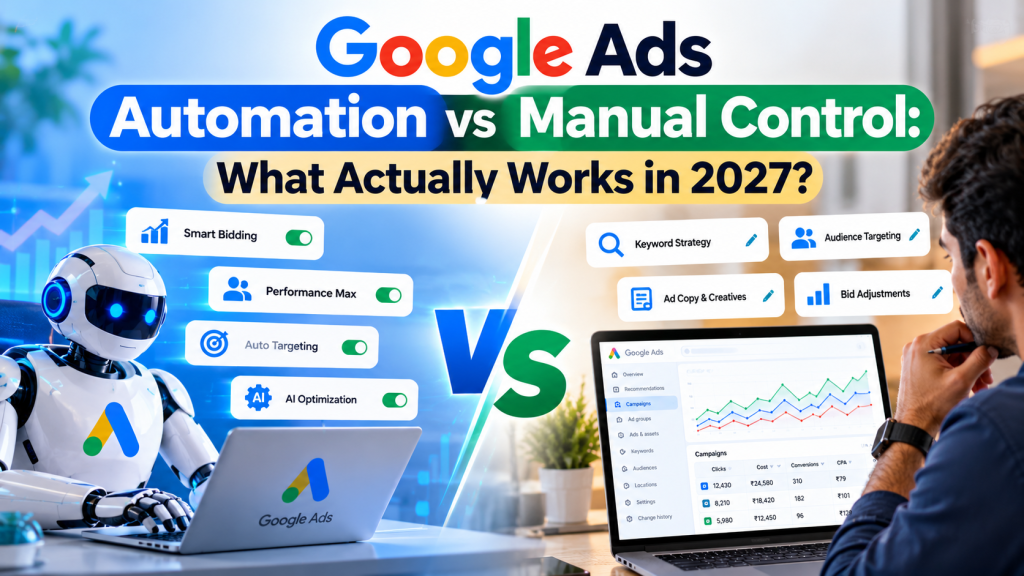
Google Ads has changed significantly over the years. From manual keyword bidding to AI-powered campaigns, advertisers now have more automation options than ever before.
But one question remains: Is Google Ads automation better than manual control?
For businesses spending money on Google Ads, choosing the right approach can directly affect lead quality, advertising costs, and return on investment (ROI).
As we approach 2027, the most effective strategy isn’t necessarily choosing automation or manual control. It’s understanding when to use each approach and how to combine them.
Let’s explore what actually works.
What Is Google Ads Automation?
Google Ads automation uses Google’s machine learning and AI technology to optimize different aspects of advertising campaigns.
Instead of manually adjusting every bid or targeting decision, advertisers allow Google’s systems to make certain adjustments based on available performance signals.
Common Google Ads automation features include:
- Smart Bidding: Automatically adjusts bids to help generate conversions or conversion value.
- Performance Max: Runs campaigns across multiple Google advertising channels.
- Broad Match Keywords: Works with Smart Bidding to identify relevant search opportunities beyond exact keyword wording.
- Responsive Search Ads: Automatically tests different combinations of headlines and descriptions.
- Automated Rules: Performs predefined actions when specific conditions are met.
Automation can save time and help advertisers respond to auction signals that would be difficult to analyze manually.
However, automation still depends on accurate tracking, appropriate campaign settings, and clear business goals.
What Is Manual Control in Google Ads?
Manual control means advertisers make more campaign decisions themselves instead of relying entirely on automated optimization.
This can include manually managing CPC bids, selecting keywords, reviewing search terms, adding negative keywords, and controlling campaign targeting.
For example, a plumbing business might want to advertise only for emergency plumbing services in specific locations.
With manual campaign management, the advertiser can select high-intent keywords such as “emergency plumber near me” and exclude unrelated searches.
Manual control provides greater visibility into certain decisions, but it also requires ongoing monitoring and optimization.
Google Ads Automation vs Manual Control: Key Differences
| Feature | Automation | Manual Control |
|---|---|---|
| Bid adjustments | AI-driven | Advertiser-managed |
| Time required | Lower for routine bidding | Higher |
| Keyword management | Can support broader matching | More direct keyword selection |
| Optimization | Uses auction-time signals | Uses manual analysis and changes |
| Conversion tracking | Essential for Smart Bidding | Important for evaluating results |
| Best suited for | Scaling with reliable data | Tightly controlled testing and targeting |
Neither approach guarantees lower costs or better conversions. Performance depends on campaign objectives, competition, tracking accuracy, and management quality.
Benefits of Google Ads Automation in 2027
1. Faster Bid Optimization
Google Smart Bidding evaluates signals such as device, location, time, and search context to determine bids at auction time.
This helps advertisers optimize toward goals such as conversions, target cost per acquisition (CPA), or return on ad spend (ROAS).
2. Better Use of Conversion Data
When conversion tracking is accurate, automated bidding can learn which traffic is more likely to produce valuable business results.
For e-commerce businesses, value-based bidding can help prioritize purchases with higher conversion values.
For service businesses, tracking qualified leads can help improve optimization beyond simple form submissions.
3. Less Manual Work
Automation reduces the need for frequent individual bid adjustments, allowing advertisers to spend more time on strategy, ad messaging, lead quality, and performance analysis.
Where Manual Control Still Matters
Although AI-powered bidding offers advantages, manual oversight remains essential.
1. Controlling Irrelevant Traffic
Advertisers should regularly review search terms and exclude clearly irrelevant queries.
For example, a company selling premium software may want to avoid searches focused exclusively on free alternatives.
2. Managing Limited Budgets
Small businesses often work with strict advertising budgets.
Manual oversight helps ensure spending remains aligned with business priorities, service locations, and customer demand.
Automated bidding does not eliminate the need for budget planning.
3. Improving Lead Quality
An automated campaign might generate many leads at a low cost, but some enquiries may not be relevant.
For example, 50 unqualified leads may be less valuable than 15 enquiries from potential customers who are ready to buy.
Advertisers must review lead quality and, where possible, send qualified-lead information back into Google Ads.
Smart Bidding vs Manual CPC: Which Is Better?
Smart Bidding and Manual CPC serve different purposes.
Smart Bidding is often worth testing when your campaign has reliable conversion tracking and a clear objective, such as generating enquiries or increasing sales.
Manual CPC may be useful when advertisers need direct bid control or are running tightly managed tests.
However, Manual CPC does not use the same auction-time conversion optimization as Smart Bidding.
For advertisers focused on conversions, a well-configured Smart Bidding strategy will often be a stronger starting point than continuously adjusting individual keyword bids.
Results should still be evaluated through campaign experiments and actual business outcomes.
What Works Best for Small Businesses in 2027?
For small businesses, the strongest approach is likely to be automation supported by human decision-making.
Here’s a practical strategy:
- Start with clear campaign objectives and high-intent keyword targeting.
- Set up accurate lead or purchase conversion tracking.
- Use Smart Bidding when appropriate for the campaign’s goals and available data.
- Review search terms and maintain relevant negative keywords.
- Monitor lead quality, cost per qualified lead, and actual sales.
- Test ad copy and improve campaign relevance regularly.
- Evaluate performance before making major campaign changes.
For businesses with limited budgets, starting with focused Search campaigns can provide better control over search intent than immediately using every available automated campaign type.
Performance Max can also be valuable, particularly when advertisers have suitable creative assets, reliable tracking, and a clear cross-channel objective.
The right choice depends on business requirements rather than a universal rule.
Common Google Ads Automation Mistakes
Even advanced automation cannot fix poor campaign fundamentals.
Common mistakes include:
- Using incorrect or duplicate conversion tracking.
- Optimizing for low-quality leads instead of qualified customers.
- Setting unrealistic Target CPA or Target ROAS goals.
- Ignoring irrelevant search queries.
- Making frequent changes without sufficient performance data.
- Assuming automated recommendations always benefit the business.
Automation works best when advertisers provide accurate data and maintain strategic oversight.
Final Verdict: Automation or Manual Control?
The future of Google Ads isn’t about replacing manual control with automation. It’s about combining the strengths of both.
Automation can handle complex bidding decisions, identify conversion opportunities, and reduce repetitive tasks. Human expertise remains essential for understanding customer intent, controlling advertising priorities, improving lead quality, and measuring profitability.
The best Google Ads strategy for 2027 is not automation versus manual control. It’s smart automation guided by clear business goals, accurate data, and continuous human oversight.
Businesses that maintain this balance will be better positioned to generate qualified leads, improve advertising efficiency, and achieve sustainable growth.