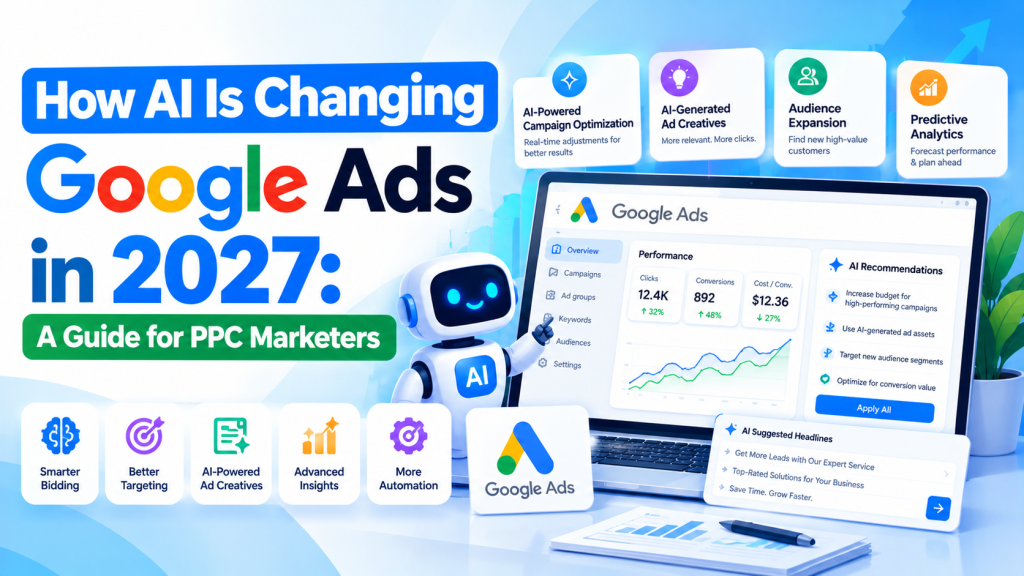
Artificial intelligence is transforming how businesses advertise on Google. From automated bidding to AI-generated ad creatives, Google Ads is becoming more intelligent and increasingly automated.
For PPC marketers, this shift brings new opportunities to improve campaign performance, reach potential customers, and reduce repetitive work.
However, it also raises an important question: Will AI replace manual Google Ads management in 2027?
The answer is no. While AI can automate many campaign activities, human expertise remains essential for strategy, budget management, lead quality, and profitability.
Let’s explore how AI is changing Google Ads and what PPC marketers should prepare for in 2027.
1. AI-Powered Bidding Is Becoming More Advanced
Google Ads Smart Bidding uses machine learning to optimize bids based on signals such as device, location, search context, and expected conversion performance.
Common automated bidding strategies include:
- Maximize Conversions
- Target CPA
- Maximize Conversion Value
- Target ROAS
These strategies help advertisers optimize toward specific business objectives without manually adjusting every keyword bid.
What PPC marketers should do: Focus on accurate conversion tracking and realistic bidding targets. Automation performs better when it receives meaningful business data.
2. AI Max Is Changing Search Campaign Optimization
AI Max for Search campaigns expands traditional keyword targeting with AI-powered search term matching and creative customization.
Instead of relying exclusively on advertiser-selected keywords, AI Max can identify additional relevant search queries using available campaign and website signals.
Google has also introduced controls for brand relevance, locations, and advertising messages.
In 2027, AI Max will become particularly relevant as Google begins transitioning legacy Dynamic Search Ads functionality into AI Max, according to its announced roadmap.
What PPC marketers should do: Test AI Max through controlled experiments and review search terms, conversion quality, and incremental results before adopting it more widely.
3. Performance Max Continues to Expand Automation
Performance Max allows businesses to advertise across multiple Google channels through a single campaign.
Google’s AI helps automate bidding, audience discovery, and ad delivery based on campaign goals.
For e-commerce businesses, Performance Max can help promote products through Shopping and other eligible placements.
For lead-generation businesses, it can reach potential customers across multiple channels.
However, automated delivery doesn’t guarantee profitable sales or qualified leads.
What PPC marketers should do: Monitor channel performance, conversion accuracy, search terms, product feeds, and lead quality.
4. AI-Generated Ad Creatives Are Becoming More Accessible
Creating engaging advertisements traditionally requires significant time and resources.
Google’s AI-powered creative tools can help advertisers generate and refine images, videos, headlines, and other advertising assets.
This can make creative testing more accessible to small businesses.
For example, an e-commerce advertiser can test multiple product-focused creative approaches without producing every variation manually.
However, AI-generated creatives still need human review.
What PPC marketers should do: Check product accuracy, brand consistency, messaging, and customer relevance before publishing AI-generated advertising assets.
5. Keyword Targeting Is Becoming More Intent-Focused
Traditional PPC management often involves manually selecting exact and phrase match keywords.
AI-powered search matching is expanding the ability to identify relevant customer searches beyond those exact terms.
This can help businesses discover additional conversion opportunities.
However, broader matching may also introduce irrelevant traffic when campaign signals or conversion goals are weak.
What PPC marketers should do: Continue reviewing search terms, maintaining negative keywords, and evaluating traffic quality.
Keyword research remains important, even as AI changes how search queries are matched with advertisements.
6. First-Party Data Is Becoming More Important
AI-driven advertising depends heavily on the quality of conversion signals.
For lead-generation campaigns, form submissions alone may not accurately represent business success.
For example, a campaign generating 100 irrelevant enquiries may appear more successful than one generating 20 qualified leads.
Connecting CRM data with Google Ads can help advertisers measure qualified enquiries and completed sales.
What PPC marketers should do: Implement reliable conversion tracking, enhanced conversions for leads, and appropriate offline conversion imports.
Better conversion data can help automated bidding focus on more valuable customer actions.
7. AI Is Changing PPC Campaign Analysis
Google is introducing AI-powered assistants to help advertisers understand performance and identify optimization opportunities.
Tools such as Ask Advisor are designed to provide campaign insights, answer performance questions, and support advertising workflows.
This can reduce the time marketers spend reviewing reports manually.
However, AI-generated recommendations should still be evaluated against actual campaign data and business objectives.
What PPC marketers should do: Use AI to support analysis, but retain human approval over important campaign decisions.
8. Advertising in AI Search Experiences Is Expanding
Google Search is evolving beyond traditional text-based queries.
AI Overviews, AI Mode, and conversational search experiences are changing how people research products and services.
Google has announced and tested advertising formats designed for these AI-powered search environments.
As these experiences develop, advertisers may find opportunities to reach users during more detailed research and purchase decisions.
What PPC marketers should do: Monitor Google’s official announcements and evaluate newly available formats based on measurable performance rather than assumptions.
AI vs Human PPC Management: What Will Matter in 2027?
| AI Automation | Human PPC Expertise |
|---|---|
| Auction-time bid optimization | Budget planning |
| Automated search matching | Search intent analysis |
| Creative generation | Brand messaging and approval |
| Audience discovery | Customer understanding |
| Performance recommendations | Strategic decision-making |
| Conversion optimization | Lead quality and profitability analysis |
The strongest approach combines automation with experienced campaign management.
How PPC Marketers Should Prepare for 2027
To stay competitive, advertisers should focus on five priorities:
- Improve conversion tracking: Measure qualified leads and sales instead of relying only on clicks.
- Test AI-powered features: Evaluate AI Max and Performance Max using controlled experiments.
- Strengthen creative quality: Develop clear, relevant advertisements supported by genuine customer benefits.
- Maintain campaign controls: Regularly review negative keywords, location targeting, and search relevance.
- Prioritize profitability: Track cost per qualified lead, customer acquisition cost, and ROAS.
Businesses using professional Google Ads services should expect more than automated campaign setup. Effective PPC management requires ongoing analysis, testing, and strategic decisions.
Conclusion
AI is changing Google Ads by making campaign bidding, targeting, creative development, and performance analysis more automated.
As we move toward 2027, PPC marketers will need to spend less time on repetitive tasks and more time understanding customers, improving conversion data, and measuring profitability.
However, automation alone isn’t a complete advertising strategy.
The future of successful Google Ads management lies in combining AI-powered technology with human expertise, accurate data, and clear business objectives.