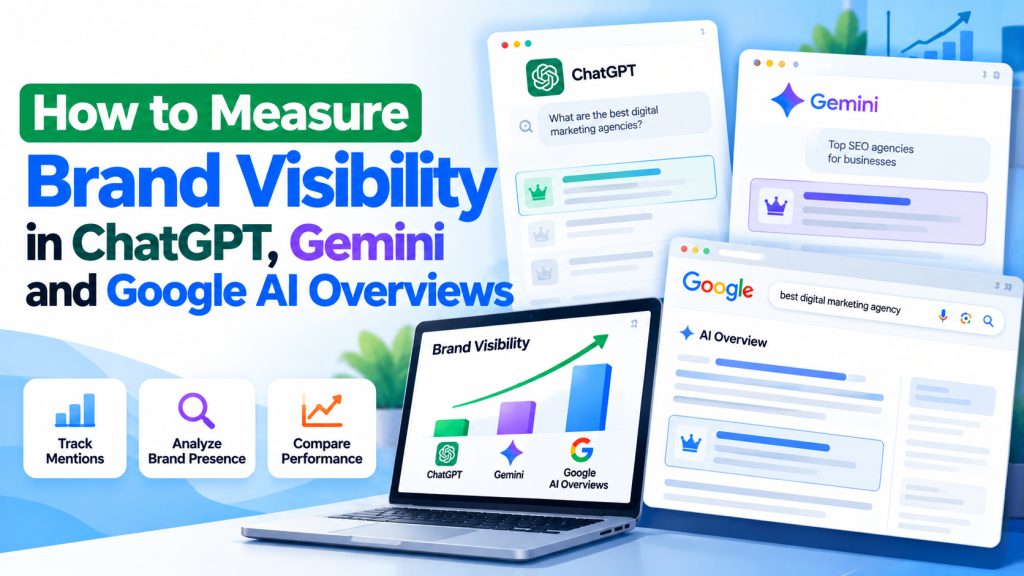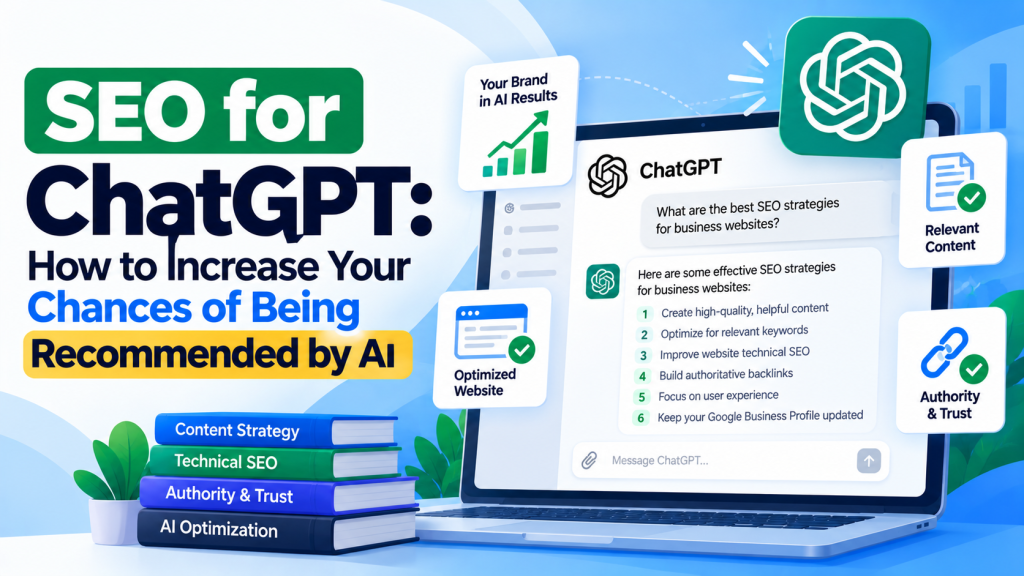
Search is changing. People are no longer using only Google to find businesses, products, and services. Many now ask ChatGPT questions like “Which is the best digital marketing agency for small businesses?” or “What are the best CRM tools for startups?”
Instead of displaying only traditional search results, ChatGPT can provide direct answers, recommendations, and links to relevant websites.
For businesses, this creates a new opportunity to reach potential customers.
But how can you optimize your website to appear in ChatGPT recommendations?
The answer involves useful content, technical accessibility, trustworthy information, and strong SEO fundamentals.
Let’s explore practical SEO strategies that can improve your chances of being discovered through AI search.
What Is SEO for ChatGPT?
SEO for ChatGPT is the process of improving your website’s discoverability, relevance, and credibility so its content has a better chance of appearing in ChatGPT search results and AI-generated answers.
This approach is often called Generative Engine Optimization (GEO) or AI Search Optimization.
Traditional SEO focuses on improving visibility in search engine results. ChatGPT SEO focuses on making your website useful and accessible when AI systems retrieve information to answer user questions.
However, ChatGPT doesn’t use a publicly documented keyword-ranking system identical to Google’s.
There is also no guaranteed method to make ChatGPT recommend your website.
1. Create Content That Directly Answers Questions
People interact with ChatGPT using natural, conversational questions.
For example, instead of searching “Google Ads agency,” someone might ask:
“How do I choose a Google Ads agency for my small business?”
Your website should provide clear answers to relevant customer questions.
Focus on:
- How-to guides
- Service comparisons
- Pricing explanations
- Frequently asked questions
- Step-by-step tutorials
Use descriptive headings and provide helpful answers without unnecessary introductions.
The goal is to make information easy for readers to understand and useful for AI-assisted research.
2. Build Topical Authority Through Quality Content
Publishing one article about a subject may not be enough to establish a strong online presence.
Create useful content covering related customer questions.
For example, a digital marketing website could publish articles about:
- Google Ads campaign optimization
- How to reduce cost per lead
- Google Ads vs Meta Ads
- Conversion tracking
- PPC campaign auditing
Connect related articles through relevant internal links.
This creates a clear content structure and helps visitors discover additional information.
Prioritize original insights and genuine expertise rather than publishing repetitive articles targeting every keyword variation.
3. Make Your Website Accessible to ChatGPT Search
ChatGPT Search uses a crawler called OAI-SearchBot to help discover website content.
If your website blocks this crawler, its ability to access and use your content in search summaries may be limited.
Check your website’s robots.txt file:
https://example.com/robots.txt
A basic permission rule is:
User-agent: OAI-SearchBot
Allow: /
Also check whether your hosting provider, firewall, or content delivery network blocks legitimate crawler requests.
Allowing OAI-SearchBot makes content eligible for discovery but doesn’t guarantee recommendations.
4. Demonstrate Experience and Credibility
AI-generated recommendations may draw on information from different sources.
Businesses should make their expertise and services easy to verify.
Include:
- Detailed service information
- Genuine customer testimonials
- Relevant case studies
- Author profiles and qualifications
- Accurate business contact details
- Clear company information
For example, instead of simply claiming expertise in PPC advertising, explain how you approach campaign optimization and measure results.
Original case studies and practical examples can make your content more useful to potential customers.
5. Optimize Content for Conversational Searches
AI search users often ask detailed questions rather than entering short keywords.
For example:
Traditional search: “Technical SEO services“
Conversational search: “How can I fix technical SEO issues preventing my website from ranking?”
Create content that addresses both the main topic and related questions.
Use natural language, clear explanations, and relevant examples.
Avoid keyword stuffing or writing awkward content solely to match AI prompts.
6. Improve Technical SEO and Website Structure
Technical SEO remains important for website discovery.
Ensure your important pages are accessible and properly maintained.
Focus on:
- Crawlable website pages
- Correct indexing settings
- Descriptive titles and headings
- Mobile-friendly design
- Clear internal linking
- Fast, reliable page loading
- Appropriate structured data
For Google AI search features, Google confirms that traditional SEO fundamentals remain relevant, without requiring special AI-specific markup.
7. Build a Trustworthy Online Presence
Your website shouldn’t be the only place where customers can find reliable information about your business.
Maintain accurate profiles on relevant business directories, professional platforms, and industry websites.
Earn genuine mentions through useful resources, partnerships, and industry contributions.
For local businesses, keep Google Business Profile details accurate.
These activities can strengthen online discoverability and credibility, although no specific number of mentions guarantees inclusion in ChatGPT recommendations.
8. Keep Your Content Updated and Accurate
Outdated information can reduce the usefulness of a website.
Review important articles regularly, particularly those discussing software, pricing, advertising platforms, and industry changes.
Update:
- Outdated statistics
- Product features
- Service information
- Screenshots and instructions
- Broken external links
Accurate, current content provides more value to users researching specific questions.
9. Track Traffic from ChatGPT
Improving AI visibility is useful, but measuring results is equally important.
Google Analytics 4 can help identify visitors arriving from ChatGPT when attribution information is available.
Navigate to:
GA4 → Reports → Acquisition → Traffic acquisition
Review identifiable ChatGPT referral traffic and track conversions such as form submissions, appointments, and purchases.
ChatGPT Search can also include utm_source=chatgpt.com in referral URLs to help website owners measure incoming traffic.
Remember that not every AI recommendation generates a website click.
ChatGPT SEO vs Traditional SEO
| Traditional SEO | ChatGPT SEO |
|---|---|
| Focuses on search visibility | Focuses on AI-assisted discovery |
| Targets relevant search queries | Addresses conversational questions |
| Measures rankings and organic traffic | Monitors AI referrals and citations |
| Uses technical SEO and quality content | Also relies on accessible, useful content |
| Supports website enquiries and sales | Can introduce businesses through AI answers |
Both approaches share important foundations and should complement each other.
Conclusion
ChatGPT and other AI-powered search experiences are changing how customers discover information and compare businesses.
To improve your chances of being recommended, focus on creating helpful content, answering customer questions, maintaining accurate business information, and ensuring your website is accessible to relevant search crawlers.
Strong traditional SEO remains a valuable foundation for AI search optimization.
The goal of SEO for ChatGPT isn’t to manipulate AI recommendations. It’s to make your business easier to discover, understand, and trust when potential customers search for solutions.