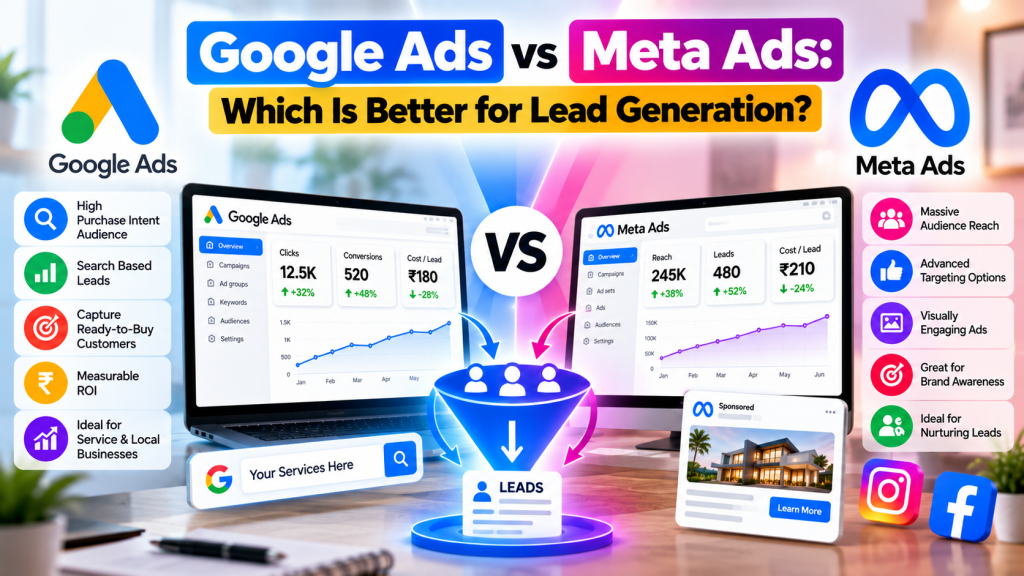
Generating quality leads is one of the biggest challenges for businesses investing in digital advertising. With multiple advertising platforms available, choosing between Google Ads and Meta Ads can be confusing.
Both platforms offer powerful targeting options, but they attract customers differently. Google Ads helps businesses reach people actively searching for products or services, while Meta Ads connects businesses with potential customers across Facebook and Instagram.
So, which platform is better for lead generation: Google Ads or Meta Ads?
The answer depends on your business goals, industry, target audience, and advertising budget. Let’s compare both platforms to understand which can deliver better results.
What Is Google Ads Lead Generation?
Google Ads is a pay-per-click (PPC) advertising platform that allows businesses to display advertisements across Google Search, YouTube, and other Google advertising channels.
For lead generation, Search campaigns are particularly effective because they target people actively looking for specific services.
For example, someone searching for “emergency plumber near me” or “digital marketing agency in Delhi” already has a clear requirement.
Professional Google Ads services help businesses identify high-intent keywords, create relevant advertisements, optimize targeting, and track enquiries.
This makes Google Ads a strong option for businesses looking to capture existing customer demand.
What Is Meta Ads Lead Generation?
Meta Ads allows businesses to promote their products and services across Facebook, Instagram, and other eligible placements.
Unlike Google Search Ads, Meta Ads can reach users who aren’t actively searching for a service but may become interested after seeing an advertisement.
For example, a person browsing Instagram might discover a home interior design company through an attractive video and submit an enquiry.
Meta also offers Instant Forms that allow users to share their contact information without leaving Facebook or Instagram.
Effective Meta Ads services focus on audience targeting, engaging creatives, lead-generation campaigns, and continuous optimization to attract potential customers.
Google Ads vs Meta Ads: Key Differences
| Feature | Google Ads | Meta Ads |
|---|---|---|
| Audience intent | High for relevant Search queries | Often discovery-driven |
| Targeting | Keywords, audiences, locations | Audiences, engagement, locations |
| Ad formats | Search, video, images | Images, videos, Reels, carousel |
| Lead generation | Website forms, calls, lead forms | Instant Forms, website, messaging |
| Cost per lead | Depends on search competition | Depends on audience and creative |
| Best for | Capturing existing demand | Creating and nurturing demand |
Both platforms can generate leads, but their effectiveness depends on the business and campaign strategy.
1. Which Platform Generates Better Quality Leads?
Lead quality matters more than the number of enquiries.
Google Search Ads often attract users with stronger purchase intent because they’re actively searching for solutions.
For example, someone searching for “book AC repair service” may be ready to schedule an appointment.
Meta Ads, on the other hand, can attract potential customers earlier in their buying journey.
A user might discover a training course on Facebook, explore its benefits, and submit an enquiry even without previously searching for it.
Google Ads is often a good choice for immediate, high-intent enquiries, while Meta Ads can work well for generating interest and building demand.
2. Google Ads vs Meta Ads: Which Has a Lower Cost Per Lead?
Cost per lead (CPL) is an important metric for evaluating advertising performance.
Cost Per Lead = Total Ad Spend ÷ Total Leads
Meta Ads may generate enquiries at a lower initial CPL through Instant Forms, while competitive Google Search keywords can have higher click costs.
However, cheaper leads aren’t always better.
Consider this hypothetical example:
| Metric | Google Ads | Meta Ads |
|---|---|---|
| Advertising Spend | ₹20,000 | ₹20,000 |
| Total Leads | 25 | 50 |
| Cost Per Lead | ₹800 | ₹400 |
| Qualified Leads | 15 | 10 |
| Cost Per Qualified Lead | ₹1,333 | ₹2,000 |
In this example, Meta Ads generates more enquiries at a lower CPL, but Google Ads produces more qualified leads.
Businesses should evaluate cost per qualified lead, not just the cost of generating contact information.
3. Which Platform Is Better for Small Businesses?
Small businesses usually have limited advertising budgets, making platform selection particularly important.
Google Ads can be effective for businesses whose customers actively search for solutions.
Examples include:
- Home repair and maintenance services
- Healthcare and dental appointments
- Legal and professional services
- Local service providers
Meta Ads can be suitable for businesses that benefit from visual promotion and customer discovery.
Examples include:
- Real estate and property businesses
- Beauty and wellness services
- Training and educational courses
- Travel and holiday packages
- Interior design and lifestyle services
The best approach is to understand customer behaviour and start with the platform most likely to generate relevant enquiries.
4. Which Platform Offers Better Audience Targeting?
Google Ads allows advertisers to target people based on relevant search keywords, geographic locations, audience signals, and campaign settings.
This makes it effective for reaching users with specific requirements.
Meta Ads uses audience information, engagement signals, and AI-powered delivery to find people likely to respond to advertisements.
Creative quality plays a major role in Meta campaign performance.
For example, a compelling video showcasing a home renovation project may attract enquiries from users who weren’t initially planning to contact a renovation company.
Both platforms offer advanced targeting, but they approach customer acquisition differently.
5. Which Platform Delivers Better ROI?
Return on investment depends on the revenue generated compared with marketing costs.
A campaign generating 100 leads isn’t necessarily more profitable than one generating 20 leads.
Businesses should monitor:
- Cost per qualified lead
- Lead-to-customer conversion rate
- Customer acquisition cost
- Revenue generated from advertising
- Return on advertising investment
Reliable conversion tracking and regular campaign analysis are essential for evaluating actual business performance.
Should You Use Google Ads and Meta Ads Together?
For many businesses, combining both advertising platforms can support a more complete lead-generation strategy.
Google Ads can capture potential customers actively searching for services, while Meta Ads can introduce your business to new audiences and reconnect with interested visitors.
For example, a real estate business might use Google Search Ads for property-related enquiries and Meta Ads to showcase projects through videos and images.
However, businesses with smaller budgets should avoid dividing their spending across too many campaigns before understanding which platform performs best.
Professional Google Ads services and Meta Ads services can help businesses plan campaigns, improve targeting, measure conversions, and optimize advertising performance.
Conclusion
Google Ads and Meta Ads are both valuable platforms for generating business leads, but neither is automatically better for every industry.
Google Ads is particularly useful when customers actively search for your products or services. Meta Ads can help businesses reach new audiences and generate demand through engaging advertising content.
The right decision depends on your business objectives, customer behaviour, budget, and expected return.
Investing in well-managed Google Ads services and Meta Ads services can help improve campaign targeting, reduce wasted spending, and generate more relevant enquiries.
Ultimately, successful lead generation isn’t about choosing the platform with the cheapest clicks. It’s about attracting qualified prospects who are more likely to become paying customers.