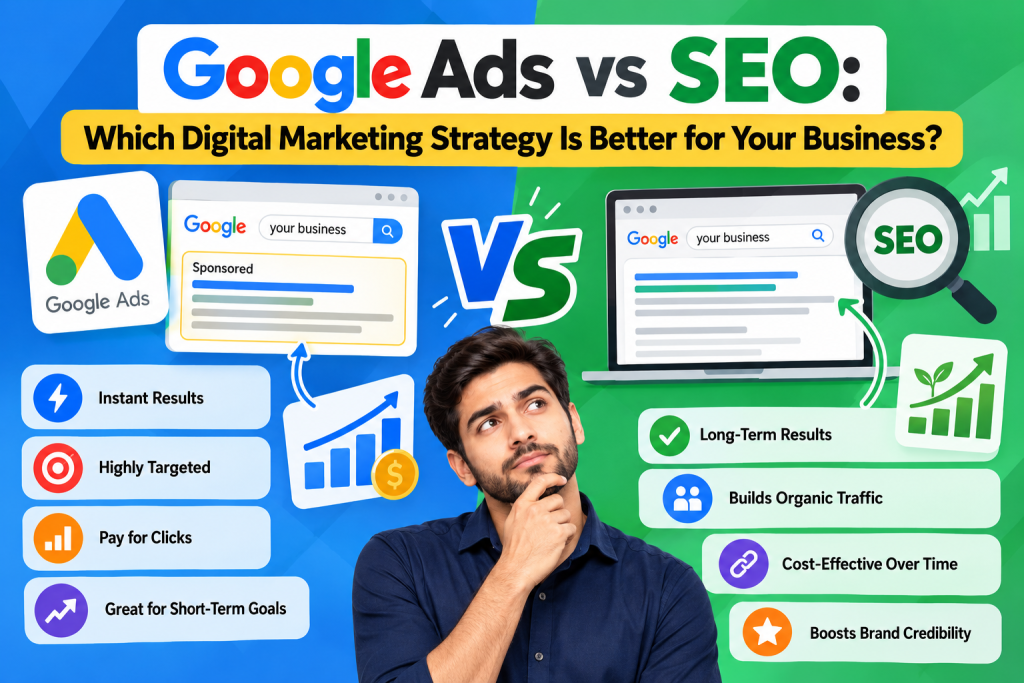
If you want to grow your business online, two strategies will come up again and again: Google Ads and SEO.
Both can help your business appear on Google, attract potential customers, generate leads, and increase sales. However, they work in very different ways.
With Google Ads, you pay to show your business in sponsored placements and can potentially start receiving targeted traffic soon after launching a campaign.
With SEO (Search Engine Optimization), you improve your website and content to earn visibility in Google’s organic search results. SEO generally takes longer, but strong rankings can continue bringing visitors without paying for every click.
So, Google Ads vs SEO—which is better for your business?
The answer depends on your goals, budget, competition, timeline, website, and how quickly you need results.
In this guide, we’ll explain Google Ads and SEO in simple terms, compare their advantages and disadvantages, and help you understand where each strategy fits into a digital marketing plan.
What Is Google Ads?
Google Ads is Google’s online advertising platform.
Businesses can create paid advertisements that may appear across Google properties and advertising partners, depending on the campaign type.
For example, when someone searches:
“plumber near me”
they may see sponsored results above or among the organic search results.
A plumbing company can use Google Ads to target people searching for services such as:
- Emergency plumber near me
- Plumbing repair services
- 24-hour plumber
- Water leak repair
- Local plumbing company
Search campaigns commonly use a pay-per-click (PPC) model, meaning advertisers typically pay when someone clicks their ad.
However, Google Ads includes several campaign types and bidding models, so PPC is only one part of the platform.
Common Types of Google Ads
Businesses can use campaign types such as:
Search Ads – Text ads that can appear when users search on Google.
Shopping Ads – Product-focused ads commonly used by ecommerce businesses.
Display Ads – Visual advertisements shown across websites and apps in Google’s advertising network.
Video Ads – Video advertising, including placements on YouTube.
Performance Max – Goal-based campaigns that can use multiple Google advertising channels and placements.
Demand Gen – Visual campaigns designed to reach and influence potential customers across eligible Google surfaces.
The right campaign type depends on your business model and marketing objective.
What Is SEO?
SEO stands for Search Engine Optimization.
SEO is the process of improving your website so search engines can better understand its content and users can find relevant pages through organic search results.
Suppose you own a kitchen renovation company.
Potential customers might search:
“kitchen renovation company”
“custom kitchen cabinets”
“kitchen designers near me”
“how much does a kitchen renovation cost?”
SEO aims to make relevant pages on your website strong candidates for searches like these.
Unlike paid search advertising, you don’t pay Google each time someone clicks your organic listing.
However, SEO isn’t necessarily “free.”
Businesses may still invest money in:
- SEO professionals
- Content creation
- Technical improvements
- Website development
- Digital PR
- Research
- SEO tools
- Content updates
SEO should therefore be viewed as an investment rather than a completely free traffic source.
Google Ads vs SEO: Quick Comparison
| Factor | Google Ads | SEO |
|---|---|---|
| Traffic Source | Paid | Organic |
| Speed | Can generate visibility quickly | Usually takes time |
| Cost Per Click | You may pay for clicks | No direct payment to Google for organic clicks |
| Long-Term Value | Traffic generally depends on continued advertising | Rankings can continue generating traffic |
| Targeting Control | High | More limited |
| Keyword Control | High | Requires earning organic visibility |
| Testing | Fast | Slower |
| Competition | Can increase advertising costs | Can increase ranking difficulty |
| Best For | Fast, controlled acquisition | Sustainable organic visibility |
| Results Guaranteed? | Yes | No |
Neither Google Ads nor SEO guarantees leads, sales, or profitability.
The effectiveness of either channel depends on factors such as targeting, competition, website quality, offer, search intent, conversion rate, budget, and execution.
How Does Google Ads Work?
Google Ads uses an auction system to determine which eligible ads can appear for a particular advertising opportunity.
For Search campaigns, advertisers commonly select keywords or other targeting signals related to the searches they want to reach.
Imagine that you provide artificial grass installation.
You might target searches related to:
artificial grass installers
synthetic turf installation
artificial lawn company
When a relevant search occurs, Google considers eligible advertisements and multiple factors to determine which ads appear and where.
It isn’t simply a case of the company willing to pay the most automatically getting the best position.
Factors such as bid, ad quality, expected impact of assets, user context, and relevance can influence the auction.
This means a successful Google Ads campaign needs more than a large budget.
It needs:
Relevant targeting + Strong ads + Good landing pages + Accurate conversion tracking + Smart bidding + Continuous optimization
How Does SEO Work?
Google uses automated systems to crawl, index, understand, and rank web content.
SEO focuses on making your website useful to visitors while helping search engines discover and understand your pages.
A strong SEO strategy generally involves several areas.
1. Keyword Research
Keyword research helps you understand what potential customers are searching for.
For example, a dermatologist might research keywords such as:
- Dermatologist near me
- Skin specialist near me
- Acne treatment
- Hair loss treatment
- Best dermatologist in [city]
But search volume alone shouldn’t decide which keywords you target.
You should also understand search intent.
Someone searching:
“what causes hair loss?”
may be researching a problem.
Someone searching:
“hair loss treatment clinic near me”
may be much closer to booking an appointment.
Both keywords can be useful, but they serve different stages of the customer journey.
2. On-Page SEO
On-page SEO involves optimizing individual pages of your website.
This can include improving:
- Page titles
- Headings
- Content
- Internal links
- Images
- URLs
- Meta descriptions
- Topic coverage
- User experience
The objective isn’t to repeat a keyword as many times as possible.
Your page should genuinely answer the user’s question or help them complete the action they came for
3. Technical SEO
Technical SEO helps search engines access, crawl, understand, and index your website efficiently.
It may include:
- Crawlability
- Indexability
- Site architecture
- Page performance
- Mobile usability
- HTTPS
- Canonicalization
- Redirect management
- XML sitemaps
- Structured data
- Duplicate-content management
A technically healthy website gives your content a stronger foundation.
4. Content SEO
Content allows businesses to target questions and topics their potential customers search for.
For example, a company offering company formation services in Dubai could publish useful articles such as:
“How Much Does It Cost to Start a Company in Dubai?”
“Mainland vs Free Zone Company: What’s the Difference?”
“Documents Required to Start a Business in Dubai”
These articles can attract users before they are ready to speak with a company.
Good content should solve the reader’s problem instead of existing purely to insert keywords.
5. Off-Page SEO
Off-page SEO involves signals and activities outside your website that can strengthen its visibility and reputation.
One important area is earning high-quality backlinks from relevant and trustworthy websites.
Businesses may earn links through:
- Useful original resources
- Digital PR
- Research and data
- Industry relationships
- Expert contributions
- Valuable tools or guides
- Newsworthy business activity
The goal should be earning legitimate mentions and links—not collecting as many low-quality links as possible.
6. Local SEO
Local SEO is particularly important for businesses serving specific locations.
Examples include:
- Dentists
- Doctors
- Restaurants
- Plumbers
- Electricians
- Salons
- Repair companies
- Lawyers
- Local contractors
- Pet grooming services
Local SEO can involve optimizing your Google Business Profile, keeping business information accurate, earning reviews, creating useful location-specific pages, and strengthening your local relevance.
Google Ads vs SEO: What’s the Main Difference?
The biggest difference is how you obtain visibility.
With Google Ads, you are paying for advertising opportunities.
With SEO, you are working to earn organic search visibility.
A simple way to understand the difference is:
Google Ads can help you buy immediate visibility. SEO helps you build organic visibility over time.
That doesn’t make one automatically better than the other.
They solve different marketing problems.
1. Google Ads vs SEO: Which Is Faster?
For most businesses, Google Ads can produce measurable traffic much faster than SEO.
Once your campaign is created, approved, funded, and eligible to serve, your ads can potentially start receiving impressions and clicks relatively quickly.
SEO usually requires more patience.
A new page may need to be discovered, crawled, indexed, evaluated, and compete against existing pages.
SEO performance can depend on factors such as:
- Website history
- Competition
- Content quality
- Technical health
- Existing authority
- Search intent
- Location
- Industry
- Quality of competing pages
There is no universal number of days or months in which SEO “should” work.
Best fit when speed matters: Google Ads
If your business needs immediate visibility for a launch, seasonal offer, new service, or lead-generation campaign, Google Ads may be useful.
2. Google Ads vs SEO: Which Costs More?
This question is more complicated than it appears.
Google Ads Costs
Google Ads can involve direct media spending every time eligible advertising interactions occur.
Your costs can depend on:
- Industry
- Location
- Keywords
- Competition
- Bidding strategy
- Target audience
- Campaign quality
- Conversion rate
Highly competitive industries can have expensive clicks.
If you spend ₹100,000 on advertising, for example, profitability depends on what that investment produces—not simply the number of clicks.
SEO Costs
Organic clicks don’t carry a direct per-click fee from Google.
But SEO can require investment in:
- Strategy
- SEO specialists
- Writers
- Developers
- Content
- Tools
- Technical fixes
- Digital PR
So the correct comparison isn’t:
Paid vs Free
It is:
Direct media investment vs investment in building organic visibility.
3. Which Gives Better Long-Term Results?
SEO can create significant long-term value when a business builds strong rankings for commercially valuable and informational searches.
A useful page may continue attracting visitors long after it was originally published.
However, organic rankings are never permanently guaranteed.
Competitors can improve their websites, search behavior can change, content can become outdated, and Google can update its search systems.
Google Ads works differently.
Paid traffic generally depends on maintaining an active campaign and sufficient budget.
If your advertising stops, the paid traffic generated by those campaigns will generally stop as well.
Long-term advantage
SEO can have a major advantage for building an owned base of search visibility.
Google Ads can still remain valuable long term when campaigns generate profitable customers consistently.
4. Which Gives You More Control?
Google Ads generally provides much more direct control over paid acquisition.
Depending on the campaign type, you can control or influence:
- Geographic targeting
- Budgets
- Bidding
- Keywords
- Audiences
- Ad messaging
- Landing pages
- Campaign schedules
- Devices
- Conversion goals
SEO doesn’t provide the same level of control.
You can optimize your pages, but you cannot simply tell Google:
“Rank my website #1 for this keyword tomorrow.”
Organic rankings are determined by Google’s search systems.
Advantage for control: Google Ads
This is one reason paid search is useful for businesses that want highly controlled marketing campaigns.
5. Google Ads vs SEO for Keyword Targeting
Google Ads can be extremely useful when you already know which search terms are commercially valuable.
For example:
“emergency plumber near me”
shows stronger immediate service intent than:
“how does plumbing work?”
With paid search, businesses can focus advertising efforts around commercially valuable queries and analyze actual search-term and conversion data.
SEO can target both transactional and informational searches.
That makes SEO particularly valuable across the entire customer journey.
A business can attract someone researching a problem today and potentially convert that person later.
6. Which Has Better Conversion Potential?
There isn’t a universal winner.
Google Ads traffic can convert extremely well when the advertiser targets strong commercial intent.
For example:
“book home vet visit”
is much closer to conversion than:
“how often should dogs visit a vet?”
But organic traffic can also convert well when the search intent and landing page are closely aligned.
Instead of assuming one channel converts better, measure:
Conversion Rate = Conversions ÷ Relevant Visits or Clicks × 100
For lead-generation businesses, don’t stop at form submissions.
Track how many leads become:
- Qualified leads
- Appointments
- Opportunities
- Customers
- Revenue
A channel generating 100 cheap leads isn’t necessarily better than one generating 30 leads that produce more customers.
7. Which Is Better for Brand Awareness?
Both channels can support brand awareness in different ways.
Google Ads can put your brand in front of relevant audiences through Search, YouTube, Display, Demand Gen, Shopping, and other eligible placements.
SEO can repeatedly expose your brand when users research problems, products, comparisons, and solutions.
Imagine someone sees your company while searching:
“best artificial grass for dogs”
and later sees it again for:
“artificial grass installation near me.”
Repeated organic visibility can help build familiarity.
For many businesses, using paid and organic search together creates broader search visibility than relying on only one.
8. Which Is Better for Local Businesses?
Both can be highly valuable.
Suppose you run an air-conditioning repair company.
A potential customer searches:
“AC repair near me.”
Google Ads can help you compete for paid visibility when the user is actively searching.
Local SEO can help strengthen your presence in organic and local search experiences.
For a local business, a strong strategy can include:
Google Ads + Google Business Profile + Local SEO + Customer Reviews + Location Pages
This creates multiple opportunities for potential customers to discover the business.
9. Which Is Better for Ecommerce?
Again, it depends on the objective.
Google Ads can be valuable for ecommerce businesses because Shopping and Performance Max campaigns can promote products directly to relevant users.
SEO can generate organic traffic to:
- Product pages
- Category pages
- Buying guides
- Comparison articles
- Educational content
- Brand pages
Imagine an e-commerce store selling natural hair oil.
Paid campaigns might target people actively shopping for hair products.
SEO content could target searches such as:
“best oils for dry hair”
“how to use rosemary oil for hair”
“hair oil for frizzy hair”
This allows the business to reach users at multiple stages of the buying journey.
Google Ads Advantages
Google Ads offers several important advantages.
Fast Visibility
Campaigns can start generating impressions and traffic relatively quickly.
Strong Targeting
Businesses can target users based on campaign-specific options such as searches, locations, audiences, demographics, devices, and other signals.
Measurable Performance
When tracking is configured correctly, advertisers can measure important actions such as leads, purchases, calls, and revenue.
Budget Control
Businesses can set and adjust campaign budgets according to their goals.
Fast Testing
Google Ads makes it possible to test:
- Offers
- Landing pages
- Keywords
- Ad messages
- Calls to action
You can gather useful market data much faster than waiting for organic rankings.
Google Ads Disadvantages
Google Ads also has limitations.
You Need Ongoing Budget
Paid visibility normally depends on continued advertising spend.
Competitive Keywords Can Be Expensive
Some industries have intense advertiser competition, which can increase acquisition costs.
Poor Management Can Waste Money
Weak targeting, broad search terms, poor conversion tracking, ineffective ads, or weak landing pages can consume budget without producing profitable results.
Traffic Doesn’t Guarantee Sales
Paying for clicks does not guarantee customers.
Your offer, website, pricing, reputation, sales process, and customer experience still matter.
SEO Advantages
SEO also offers major benefits.
Long-Term Organic Visibility
Strong pages can continue attracting search traffic over time.
No Direct Charge for Each Organic Click
Google doesn’t charge your business whenever someone clicks a standard organic search result.
Wider Funnel Coverage
SEO can target searches across awareness, research, comparison, and purchase stages.
Builds a Content Asset
Useful content remains part of your website and can continue supporting users, sales teams, internal linking, and other marketing channels.
Can Strengthen Brand Visibility
Repeatedly appearing for relevant industry searches can increase familiarity with your brand.
SEO Disadvantages
SEO isn’t a quick or guaranteed growth strategy.
Results Can Take Time
Organic growth may require months of consistent work, particularly in competitive markets.
Rankings Aren’t Guaranteed
Publishing high-quality content does not guarantee a particular ranking.
Competition Can Be Strong
Established competitors may already have extensive content, strong brands, links, and technically mature websites.
Algorithms and Search Experiences Change
Search engines continually improve and change how information is ranked and displayed.
SEO therefore requires ongoing monitoring and adaptation.