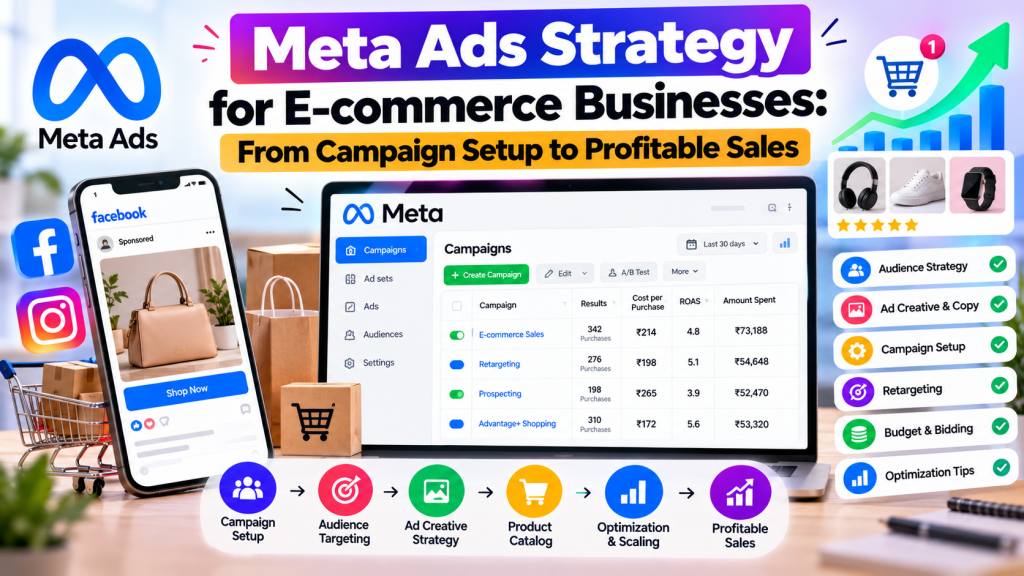
Running Meta Ads for your e-commerce store but struggling to generate profitable sales? You’re not alone. Many online businesses spend money on Facebook and Instagram advertising without achieving consistent returns.
The problem isn’t always the advertising budget. Poor campaign structure, ineffective creatives, incorrect audience targeting, and weak conversion tracking can all affect performance.
A successful Meta Ads strategy for e-commerce focuses on attracting potential buyers, generating purchases, and improving profitability.
This guide explains how to set up, manage, and optimize Meta Ads campaigns for sustainable e-commerce growth.
Why Meta Ads Is Important for E-commerce Businesses
Meta Ads allows online businesses to reach potential customers across Facebook, Instagram, Reels, and other eligible placements.
Unlike search advertising, Meta Ads helps businesses introduce products to people who may not be actively looking for them.
For example, a customer scrolling through Instagram might discover a skincare product through a demonstration video and decide to purchase it.
Meta offers several features for e-commerce advertisers, including:
- Sales-focused campaigns
- Advantage+ AI-powered advertising
- Product catalog advertisements
- Website visitor retargeting
- Image, video, carousel, and Reels ads
When used strategically, these features can support product discovery, customer acquisition, and repeat purchases.
1. Set Up Meta Pixel and Conversions API
Before launching advertisements, accurate conversion tracking is essential.
The Meta Pixel tracks customer actions on your website, while the Conversions API (CAPI) can send relevant conversion data through a server connection.
Important e-commerce events include:
- ViewContent
- AddToCart
- InitiateCheckout
- Purchase
Ensure Purchase events include accurate transaction values and currency.
If Pixel and CAPI report the same purchase, configure event deduplication to avoid double-counting.
Correct tracking helps Meta optimize campaigns toward customers more likely to purchase.
2. Choose the Right Campaign Objective
For e-commerce businesses focused on online orders, the Sales objective is generally the most relevant starting point.
Configure your campaign to optimize for website purchases when reliable purchase tracking is available.
Avoid selecting Traffic simply because clicks are cheaper. A campaign optimized for website visits may generate visitors who are less likely to purchase.
Advantage+ sales campaign options can also be tested where available, particularly when sufficient conversion data and creative assets are available.
3. Build a Simple Campaign Structure
Complicated campaign structures can divide data and budgets across too many ad sets.
Start with a manageable structure based on your product range and business goals.
For example:
| Campaign | Purpose |
|---|---|
| Prospecting Sales | Reach potential new customers |
| Retargeting Sales | Reconnect with interested visitors |
| Product Category Campaign | Promote a specific category when justified |
For small e-commerce stores, one focused Sales campaign may be sufficient initially.
Avoid creating separate campaigns for every product without a clear reason.
4. Target the Right Audience
Audience targeting plays an important role in e-commerce advertising.
Meta offers broad targeting, Advantage+ audience options, custom audiences, and lookalike audiences.
Broad targeting allows Meta’s delivery system to identify potential buyers using available signals.
Custom audiences can help reach people who previously interacted with your store, while lookalike audiences may help discover users similar to existing customers.
Practical tip: Test audience approaches based on actual purchase performance rather than assuming narrow interest targeting always delivers better results.
5. Create High-Converting Ad Creatives
Creative quality is one of the most important factors in Meta Ads performance.
Your advertisement should quickly communicate what the product does and why someone should buy it.
Effective creative formats include:
- Product demonstration videos
- Customer testimonials
- User-generated content (UGC)
- Problem-and-solution videos
- Lifestyle product images
- Carousel advertisements
For example, instead of showing only an image of a kitchen cleaning product, demonstrate how it solves a common cleaning problem.
Use clear headlines, genuine product benefits, and direct calls to action such as Shop Now or Order Today.
6. Use Product Catalog Ads
Product catalog advertising allows businesses to promote products using information from a connected catalog.
Catalog ads can display relevant products to potential customers based on eligible campaign settings and delivery signals.
For stores with multiple products, this reduces the need to create individual advertisements for every item.
Keep product titles, images, prices, availability, and website links accurate.
A well-maintained catalog supports more relevant advertising and reduces product-related customer confusion.
7. Build an Effective Retargeting Strategy
Not every customer purchases during their first website visit.
Retargeting helps reconnect with people who previously viewed products, added items to their cart, or interacted with your business.
For example, a customer who added a product to their cart but didn’t complete checkout may respond to an advertisement highlighting delivery information, customer reviews, or product benefits.
Exclude recent purchasers when the objective is acquiring new customers, where appropriate.
Keep retargeting audience sizes and frequency in mind to avoid unnecessary repetition.
8. Optimize Product Pages for Conversions
Even excellent Meta Ads cannot compensate for a poor shopping experience.
Your product pages should include:
- Clear product images and descriptions
- Accurate pricing and availability
- Visible Add to Cart and Buy Now buttons
- Mobile-friendly navigation
- Genuine customer reviews
- Transparent shipping and return policies
- A simple, secure checkout process
If visitors frequently add products to their carts but rarely purchase, investigate checkout friction, unexpected shipping charges, and payment failures before changing ad targeting.
9. Track ROAS and Actual Profitability
Return on Ad Spend (ROAS) measures revenue attributed to advertising compared with advertising spend.
ROAS = Attributed Revenue ÷ Advertising Spend
For example, if you spend ₹10,000 and generate ₹40,000 in attributed revenue, your ROAS is 4.
However, a high ROAS doesn’t automatically mean your business is profitable.
You must also consider product costs, shipping, payment fees, discounts, returns, and other expenses.
Track important metrics such as:
| Metric | Purpose |
|---|---|
| ROAS | Measures attributed advertising revenue efficiency |
| Cost Per Purchase | Shows advertising cost per order |
| Conversion Rate | Measures purchase efficiency |
| Average Order Value | Tracks average customer spending |
| Customer Acquisition Cost | Measures the cost of acquiring customers |
Understanding your break-even ROAS helps you make better decisions about advertising profitability.
10. Test, Optimize, and Scale Carefully
Successful Meta advertising requires continuous improvement.
Review creative performance, purchase costs, ROAS, and website conversion rates regularly.
Test different creative angles, product demonstrations, and messaging approaches.
When a campaign consistently delivers profitable results, evaluate opportunities to increase investment gradually.
Avoid making multiple major changes simultaneously, as this makes it difficult to identify what improved or reduced performance.
Conclusion
Building a profitable Meta Ads strategy for e-commerce requires more than launching advertisements and increasing budgets.
The foundation lies in accurate conversion tracking, effective campaign structure, engaging product creatives, relevant audiences, and a smooth shopping experience.
Businesses should focus on actual purchase performance and profitability rather than clicks or impressions alone.
The most effective Meta Ads strategy combines data-driven advertising, continuous creative testing, and a customer-focused shopping experience to turn advertising spend into sustainable sales growth.